The Start of Something New
Monday, June 9, 2008
College Essay: Something New in my Life

Sunday, June 1, 2008
"LIVING IN A PREJUDICE WORLD" by Lourdes Vicuna and Sumit Pal
Living in a Prejudice world
PREJUDICE
Extenuating issues on judging others based on their looks, nationality, what they eat or how they speak leads us to a path of ignorance.
The society we live in is filled with haphazard decisions.
We are all equal in this world, but discredited based on appearance.
The inherent characteristics we posses are overshadowed, along with our visions.
PREJUDICE
We compromise our voice in society with our feelings of uncertainty and accept suppressing remarks.
Even those in an asylum would not acquiesce with the prejudice in this world.
Animosity was expressed by Capitalists after hearing of Communism.
However, prudent feelings make situations worse by dilating prejudice behavior directed to us.
PREJUDICE
And when the prejudice person is confronted, a skeptical attitude is given.
The disparity in one’s heart, just augments day by day.
The reason? There isn’t any, the amicable target doesn't look for revenge because he or she is equable.
Anybody with diffidence is an open target for those who are ruled by a prejudice life.
No one can repudiate what they see and hear when they live in a prejudice world.
PREJUDICE
Reclusive individuals live in solemnity.
This world is filled with stolid individuals who have incessant comments and hypothetical judgments about others who never did anything to anybody.
And so others join to discourse.
PREJUDICE
Exposure to satirical feelings and improper judgment is unethical.
We should laud each other for our accomplishments, impute one another, and live under jubilation.
Being perceptive is one thing that many people don’t consider.
However, we follow a derivative path with a stagnant attitude.
PREJUDICE
Extenuating issues on judging others based on their looks, nationality, what they eat or how they speak leads us to a path of ignorance.
The society we live in is filled with haphazard decisions.
We are all equal in this world, but discredited based on appearance.
The inherent characteristics we posses are overshadowed, along with our visions.
PREJUDICE
We compromise our voice in society with our feelings of uncertainty and accept suppressing remarks.
Even those in an asylum would not acquiesce with the prejudice in this world.
Animosity was expressed by Capitalists after hearing of Communism.
However, prudent feelings make situations worse by dilating prejudice behavior directed to us.
PREJUDICE
And when the prejudice person is confronted, a skeptical attitude is given.
The disparity in one’s heart, just augments day by day.
The reason? There isn’t any, the amicable target doesn't look for revenge because he or she is equable.
Anybody with diffidence is an open target for those who are ruled by a prejudice life.
No one can repudiate what they see and hear when they live in a prejudice world.
PREJUDICE
Reclusive individuals live in solemnity.
This world is filled with stolid individuals who have incessant comments and hypothetical judgments about others who never did anything to anybody.
And so others join to discourse.
PREJUDICE
Exposure to satirical feelings and improper judgment is unethical.
We should laud each other for our accomplishments, impute one another, and live under jubilation.
Being perceptive is one thing that many people don’t consider.
However, we follow a derivative path with a stagnant attitude.
Monday, May 12, 2008
Saturday, May 10, 2008
Journal Entry- May 6, 2008
Aim: How can we compare and contrast college essays to brainstorm on what we think are the key components of a good college essay?
Do Now: Based on the research you have done on the college essay, list three things that you have noticed about the requirements for writing a college essay.
Do Now: Based on the research you have done on the college essay, list three things that you have noticed about the requirements for writing a college essay.
Response: The three things that i have noticed as requirements for writting a college essay are: 1. most college essays are about personal experiences, 2. the college essay should only be about one page long, 3. you must answer the question you are asked for the college essay.
Accommodations: handouts, technology, dictionaries, teacher will re-read any questions. For less proficient readers: To help these students through any difficulty vocabulary and syntax in this essay, encourage them to focus on one sentence at a time, make sure they understand it, then read on.
Customize for ELL (where necessary): may have difficulty understanding the Run On sentences in the passive voice. Model how to break them into shorter sentences and to rephrase them in the active voice to facilitate comprehension.
Teacher’s Model: Brief Recall of Yesterday’s lesson with Hugh Gallagher’s college essay 5 mins
Teacher’s Model of the Use of Venn Diagram: show all of the possible mathematical or logical relationships between sets (groups of things). In this case, a venn diagram will be used to illustrate how (A) Hugh Gallagher’s is both alike and different to (B) your researched college Give only 3 entries per column.. Form Groups of 4 and select the best annotated college essay for B column 2 people will work on Venn Diagram

Teacher’s Model: Brief Recall of Yesterday’s lesson with Hugh Gallagher’s college essay 5 mins
Teacher’s Model of the Use of Venn Diagram: show all of the possible mathematical or logical relationships between sets (groups of things). In this case, a venn diagram will be used to illustrate how (A) Hugh Gallagher’s is both alike and different to (B) your researched college Give only 3 entries per column.. Form Groups of 4 and select the best annotated college essay for B column 2 people will work on Venn Diagram

3.Essay B
The other two students will use the College Essay Scoring Rubric present a list of at least 10 key components of writing/presenting a college essay.
Share out.
The other two students will use the College Essay Scoring Rubric present a list of at least 10 key components of writing/presenting a college essay.
Share out.
Journal Entry- May 2-5, 2008
Aim: What topic do you think would make a good personal essay for a college admissions essay?
Do Now (5mins): If you were writing your autobiography right now, what is the first memorable event that would have to be included?
Response: I think that the most memorable moment that comes to mind would have to be when I entered High School. This is fresh in my memory, which means that I would not have a hard time remembering facts that are essential in my essay.
Read-Aloud and Analysis of Hugh Gallagher’s personal essay: (10 mins)
1. What does it mean to be a dynamic person (character)?
According to Dictionary.com, a dynamic character is one "who undergoes a permanent change in outlook or character during the story; also called [developing character]"
2. Is this essay rich in imagery? Identify them.
This essay has a lot of imagery and you could tell because when you read the essay, he makes you feel as if he was actually talking to you. For example, he explained how he once helped other witth great detail; "Using only a hoe and a large glass of water, I once single-handedly defended a small village in the Amazon Basin from a horde of ferocious army ants.".
3. Do you notice any alliteration?
Yes, alliteration is present with the letter w, "I woo women with my sensuous...".
4. Is the vocabulary extensive, eloquent (well expressed)?
Yes, there is a good use of vocabulary which makes the essay look professional but adequate.
5. What makes it memorable, fluent, or persuasive?
This essay stands out for its content. The author repeatedly uses "I am" to explain the things that are memorable to him. What makes him fluents, is the constant use of the phrase "I". And his persuassiveness is short but to the point when after explaining the many things he has done, he says, "But I have not yet gone to college.".
Accommodations: handouts, technology, dictionaries, teacher will re-read any questions. For less proficient readers: To help these students through any difficulty vocabulary and syntax in this essay, encourage them to focus on one sentence at a time, make sure they understand it, then read on.
Customize for ELL (where necessary): may have difficulty understanding the Run On sentences in the passive voice. Model how to break them into shorter sentences and to rephrase them in the active voice to facilitate comprehension.
Cooperative Learning: (10-15mins)
Locate an online Thesaurus or open MS Word, click on tools, then use the thesaurus to help you with vocabulary words that could describe your life changing experience.
Form groups of 4 and use the T Chart handout and do the following:
Left side: Make a list of 2 experiences that have changed you
Right side: Create a list that could describe that experience
Teacher’s T-Chart Model Example:
(significant experience)First Day Teaching
Estatic, scared, frustrating, exhilarating, fun, exciting, exhausting
Achievement (turning in my thesis to my adviser)
Felt relieved, what to do with myself now?
(significant experience)First crush
Shy, embarrassed, mature
Students will share out on their Cooperative Learning: (5mins)
Now Teacher will instruct students to write two additional experiences that have changed them, then stand. Teacher will instruct students to move in clockwise direction (around the desk) to the next open notebook or T-Chart and fill in the right side of the T-Chart with words that could also describe that experience. This will be a timed session and upon hearing the teacher say “switch” students will move to the next T-Chart….Almost like musical chairs.
(5 mins) Address the Aim question with exit journal entry and whole class discussion: Students will volunteer what they think would work for them if they were to write a personal essay.
Procedure: Teacher is usually welcoming students outside door and students would be instructed what to do such as: get assigned laptops and start the do now.
Materials:
Laptops, notebooks, pens, pencils
Overhead projector
Hyperlink to Hugh Gallagher’s college essay
Handouts (T-Charts) and Homework.
Dictionaries, Thesaurus (online or on laptops)
Works Cited:
Encarta® World English Dictionary © 1999 Microsoft Corporation. All rights reserved.
Developed for Microsoft by Bloomsbury Publishing Plc.
Hugh Gallagher’s college essay
Do Now (5mins): If you were writing your autobiography right now, what is the first memorable event that would have to be included?
Response: I think that the most memorable moment that comes to mind would have to be when I entered High School. This is fresh in my memory, which means that I would not have a hard time remembering facts that are essential in my essay.
Read-Aloud and Analysis of Hugh Gallagher’s personal essay: (10 mins)
1. What does it mean to be a dynamic person (character)?
According to Dictionary.com, a dynamic character is one "who undergoes a permanent change in outlook or character during the story; also called [developing character]"
2. Is this essay rich in imagery? Identify them.
This essay has a lot of imagery and you could tell because when you read the essay, he makes you feel as if he was actually talking to you. For example, he explained how he once helped other witth great detail; "Using only a hoe and a large glass of water, I once single-handedly defended a small village in the Amazon Basin from a horde of ferocious army ants.".
3. Do you notice any alliteration?
Yes, alliteration is present with the letter w, "I woo women with my sensuous...".
4. Is the vocabulary extensive, eloquent (well expressed)?
Yes, there is a good use of vocabulary which makes the essay look professional but adequate.
5. What makes it memorable, fluent, or persuasive?
This essay stands out for its content. The author repeatedly uses "I am" to explain the things that are memorable to him. What makes him fluents, is the constant use of the phrase "I". And his persuassiveness is short but to the point when after explaining the many things he has done, he says, "But I have not yet gone to college.".
Accommodations: handouts, technology, dictionaries, teacher will re-read any questions. For less proficient readers: To help these students through any difficulty vocabulary and syntax in this essay, encourage them to focus on one sentence at a time, make sure they understand it, then read on.
Customize for ELL (where necessary): may have difficulty understanding the Run On sentences in the passive voice. Model how to break them into shorter sentences and to rephrase them in the active voice to facilitate comprehension.
Cooperative Learning: (10-15mins)
Locate an online Thesaurus or open MS Word, click on tools, then use the thesaurus to help you with vocabulary words that could describe your life changing experience.
Form groups of 4 and use the T Chart handout and do the following:
Left side: Make a list of 2 experiences that have changed you
Right side: Create a list that could describe that experience
Teacher’s T-Chart Model Example:
(significant experience)First Day Teaching
Estatic, scared, frustrating, exhilarating, fun, exciting, exhausting
Achievement (turning in my thesis to my adviser)
Felt relieved, what to do with myself now?
(significant experience)First crush
Shy, embarrassed, mature
Students will share out on their Cooperative Learning: (5mins)
Now Teacher will instruct students to write two additional experiences that have changed them, then stand. Teacher will instruct students to move in clockwise direction (around the desk) to the next open notebook or T-Chart and fill in the right side of the T-Chart with words that could also describe that experience. This will be a timed session and upon hearing the teacher say “switch” students will move to the next T-Chart….Almost like musical chairs.
(5 mins) Address the Aim question with exit journal entry and whole class discussion: Students will volunteer what they think would work for them if they were to write a personal essay.
Procedure: Teacher is usually welcoming students outside door and students would be instructed what to do such as: get assigned laptops and start the do now.
Materials:
Laptops, notebooks, pens, pencils
Overhead projector
Hyperlink to Hugh Gallagher’s college essay
Handouts (T-Charts) and Homework.
Dictionaries, Thesaurus (online or on laptops)
Works Cited:
Encarta® World English Dictionary © 1999 Microsoft Corporation. All rights reserved.
Developed for Microsoft by Bloomsbury Publishing Plc.
Hugh Gallagher’s college essay
Journal Entry- April 30, 2008
Aim: This Lesson will assist students in writing a thorough and descriptive college essay. The skills learned will prepare students for both their senior thesis and college careers.
Do Now: What do you think is the objective(s) for College Essays? (write in your journals).
Volunteers will share their thoughts.
Response: I think that the objective of a college essay is for the college to know who you are. It could also be for the colleges to see you writing skills through telling a personal experiences. It is important to not lie or exaggerate because that would be a first bad impression.
Cooperative Learning and Brainstorming: You were asked to research, read, and bring in a sample essay. Please form groups of fours and exchange your essay with your peers and identify the following:
1. Title of Essay. If the essay does not have a title then create one based on the information given.
2. There are seven topic selections: assign your essay to one of the topics and give evidence/support based on your selection.
3. Did the applicant address the topic question?
4. Does the introduction engage the reader? Does the conclusion provide closure?
5. Does the applicant use concrete experiences as supporting details? Label with #5
6. Are transitions used appropriately? Circle them
7. What about the essay is memorable? Label with #7
8. What's the worst part of the essay? Label with #8 (if any)
9. What parts of the essay need elaboration or are unclear? Label with #9
10. What parts of the essay do not support the main argument? Label with #10
11. Is every single sentence crucial to the essay? This must be the case.
12. What does the essay reveal about my personality?
Return essay with notes to peers. Share out.
Do Now: What do you think is the objective(s) for College Essays? (write in your journals).
Volunteers will share their thoughts.
Response: I think that the objective of a college essay is for the college to know who you are. It could also be for the colleges to see you writing skills through telling a personal experiences. It is important to not lie or exaggerate because that would be a first bad impression.
Cooperative Learning and Brainstorming: You were asked to research, read, and bring in a sample essay. Please form groups of fours and exchange your essay with your peers and identify the following:
1. Title of Essay. If the essay does not have a title then create one based on the information given.
2. There are seven topic selections: assign your essay to one of the topics and give evidence/support based on your selection.
3. Did the applicant address the topic question?
4. Does the introduction engage the reader? Does the conclusion provide closure?
5. Does the applicant use concrete experiences as supporting details? Label with #5
6. Are transitions used appropriately? Circle them
7. What about the essay is memorable? Label with #7
8. What's the worst part of the essay? Label with #8 (if any)
9. What parts of the essay need elaboration or are unclear? Label with #9
10. What parts of the essay do not support the main argument? Label with #10
11. Is every single sentence crucial to the essay? This must be the case.
12. What does the essay reveal about my personality?
Return essay with notes to peers. Share out.
Journal Entry- April 28-29, 2008
Welcome Back. Hope you had a well rested and fun Spring Break.
Objective: Students will submit their final resumes to include in their binders.
Students will proof-read each other’s speech.
Do Now: Submit Resumes and include in bindersUse proof reading style sheet to proof read each other’s speech.
Objective: Students will submit their final resumes to include in their binders.
Students will proof-read each other’s speech.
Do Now: Submit Resumes and include in bindersUse proof reading style sheet to proof read each other’s speech.
Journal Entry- April 10, 2008
Aim: Students will use the internet to research the elemnets of writing an effective resume
Students will create their own resume. Students will review each others’ resume and critique them according to the Resume Assessment Table.
Do Now: Why write a resume?
The purpose of a resume is to give people a brief overview of who you are when you are applying for a job.
Students will create their own resume. Students will review each others’ resume and critique them according to the Resume Assessment Table.
Do Now: Why write a resume?
The purpose of a resume is to give people a brief overview of who you are when you are applying for a job.
Journal Entry- April 7-10, 2008
Aim: Students will begin their biography research and power point for their presentation.
Objectives:
1. To give a presentation that provides a clear understanding of the speaker’s life, ambitions, contribution to protest, objectives of protest, and their protest targeted (whom or what is being protested.)
2. To give a fully recited speech with minimum, if any, dependency on prompts that clearly defines the speaker’s contribution to protest, objectives of protest, & their protest targeted (whom or what is being protested.)
3. To have a clear understanding of the speaker’s style, attitude, and protest objective and to demonstrate this through the recited speech.
Task: To present, through public speaking, a biography and a 1 ½ minute speech from a selected speaker firmly noted & influential in the American historical & literary protest tradition.
Procedure:
1. To first present a biography that highlights the speaker’s ambitions, accomplishment, & contribution to protest. You have two options to do present this: Blog page or Power Point using 5 sections or 5 slides for each medium. Each section or slide must have the necessary headers Biography (included on cover page), ambitions, accomplishments, contribution to protest, works cited. Your presentation time limit is 1.5 mins.
2. To research, select, & recite a speech from the speaker that is at LEAST 1 ½ (one & a half) minutes in duration that involves specific protest of a specifc issue.
Rubric: 20 Pts
Demonstration of proper research & information. (4pts)
How well presentation and speech are organized and presented. (4pts)
Articulation: clarity of speech, voice projection, attention to the audience. (4pts)
Ability to capture the speaker’s persona, attitude, style, etc. (6pts)
Creativity. (2pts)
Any speech, which demonstrates a lack of memorization and a dependency on reading or prompt cards, will receive an immediate zero(0) grade.
Speeches that do not reach nor meet time criteria (1 ½ minutes) will receive a severe deduction and, or, risk an immediate zero (0) grade.
Objectives:
1. To give a presentation that provides a clear understanding of the speaker’s life, ambitions, contribution to protest, objectives of protest, and their protest targeted (whom or what is being protested.)
2. To give a fully recited speech with minimum, if any, dependency on prompts that clearly defines the speaker’s contribution to protest, objectives of protest, & their protest targeted (whom or what is being protested.)
3. To have a clear understanding of the speaker’s style, attitude, and protest objective and to demonstrate this through the recited speech.
Task: To present, through public speaking, a biography and a 1 ½ minute speech from a selected speaker firmly noted & influential in the American historical & literary protest tradition.
Procedure:
1. To first present a biography that highlights the speaker’s ambitions, accomplishment, & contribution to protest. You have two options to do present this: Blog page or Power Point using 5 sections or 5 slides for each medium. Each section or slide must have the necessary headers Biography (included on cover page), ambitions, accomplishments, contribution to protest, works cited. Your presentation time limit is 1.5 mins.
2. To research, select, & recite a speech from the speaker that is at LEAST 1 ½ (one & a half) minutes in duration that involves specific protest of a specifc issue.
Rubric: 20 Pts
Demonstration of proper research & information. (4pts)
How well presentation and speech are organized and presented. (4pts)
Articulation: clarity of speech, voice projection, attention to the audience. (4pts)
Ability to capture the speaker’s persona, attitude, style, etc. (6pts)
Creativity. (2pts)
Any speech, which demonstrates a lack of memorization and a dependency on reading or prompt cards, will receive an immediate zero(0) grade.
Speeches that do not reach nor meet time criteria (1 ½ minutes) will receive a severe deduction and, or, risk an immediate zero (0) grade.
Journal Entry- April 1-2, 2008
Aim: Students will complete a written and multimedia assignment at the end of this mini unit.
Teacher will assign numbers 1 through 4 to students
Cooperative Learning: Students will be assigned numbers 1-4
1=Slavery (1700s-1865)
2=War (WWI and Vietnam)
3=Treatment of Hispanics in America (1960s)
4=Treatment of Native Americans (earliest as possible to 1924)
Students will group themselves according to number and start talking about the importance of their assigned topic.
Students will become activists and research great speeches on their topic and list the speaker, cite source, what is the speech about, pros vs. cons, who, what, when, why, where, how, audience etc.
Take notes on what everyone else in your group has to say for your own purpose of writing a persuasive speech.
Share out.
Teacher will assign numbers 1 through 4 to students
Cooperative Learning: Students will be assigned numbers 1-4
1=Slavery (1700s-1865)
2=War (WWI and Vietnam)
3=Treatment of Hispanics in America (1960s)
4=Treatment of Native Americans (earliest as possible to 1924)
Students will group themselves according to number and start talking about the importance of their assigned topic.
Students will become activists and research great speeches on their topic and list the speaker, cite source, what is the speech about, pros vs. cons, who, what, when, why, where, how, audience etc.
Take notes on what everyone else in your group has to say for your own purpose of writing a persuasive speech.
Share out.
Wednesday, April 9, 2008
Public Speaking Project
Attention: Below you will find a presentation on Charles Alexander Eastman, who was a Native American Activist. Some highlights of his life are: Ambitions, Accomplishments, and Contribution to Protest. In the very end, you will find a speech he gave before he and others introduced 32 YMCA's for Native Americans. This wraps up my Public Speaking Project, which I presented on April 14, 2008.


Information Technology High School
Ms. Hyde
English 6H
04/8/08
Lourdes Vicuna
After closing his medical practice in St. Paul, Eastman accepted a position as field secretary and organizer for the International Committee of the Young Men's Christian Association (YMCA). He spent the following three years traveling throughout the U.S. and Canada, visiting many Indian tribes in an attempt to create new YMCAs. Eastman established 32 Indian groups of the YMCA. Here he is expressing his views in a speech before an International Convention of YMCAs of North America, he said:
“I sometimes forget my color when I stand before my audiences. And then, I sometimes wish we were color blind; how much easier it would be for us to do Christian work. But never mind; we will do the best we can. It is only through the young men that we can save the Indian race. Children must early learn the beauty of generosity. They are taught to give what they prize most, that they may taste the happiness of giving. The true Indian sets no price upon either his property or his labor. His generosity is limited only by his strength and ability. For there is more happiness in giving, than in receiving. But people don’t see that in an Indian boy. An Anglo will only see what is on the outside, but never the inside. It is these young men that we see here who will show them the true meaning of being humble. Since it is admittedly impossible for the Indian to continue to exist as a separate race, we must use what is at our hands. We must be wise when doing so, and the Young Men’s Christian Association can be made a great power in their behalf if it is rightly managed.”
Sources:
http://www.u-s-history.com/pages/h3898.html
http://books.google.com/booksid=nUrhXE8jZnYC&pg=PA88&lpg=PA88&dq=22i+sometimes+forget+my+color+when+i+stand+before+audiences22&source+web&ots+MSOV9Ftupc&sig=WgU7npXjv-RGeiwo-unjGuur8&hl+en#PPA88,M1
http://digitalcommons.unl.edu/cgi/viewcontent.cgi?article=1012&content=historyfacpub
Note:
-Everything in bold is from me, Lourdes Vicuna


Information Technology High School
Ms. Hyde
English 6H
04/8/08
Lourdes Vicuna
After closing his medical practice in St. Paul, Eastman accepted a position as field secretary and organizer for the International Committee of the Young Men's Christian Association (YMCA). He spent the following three years traveling throughout the U.S. and Canada, visiting many Indian tribes in an attempt to create new YMCAs. Eastman established 32 Indian groups of the YMCA. Here he is expressing his views in a speech before an International Convention of YMCAs of North America, he said:
“I sometimes forget my color when I stand before my audiences. And then, I sometimes wish we were color blind; how much easier it would be for us to do Christian work. But never mind; we will do the best we can. It is only through the young men that we can save the Indian race. Children must early learn the beauty of generosity. They are taught to give what they prize most, that they may taste the happiness of giving. The true Indian sets no price upon either his property or his labor. His generosity is limited only by his strength and ability. For there is more happiness in giving, than in receiving. But people don’t see that in an Indian boy. An Anglo will only see what is on the outside, but never the inside. It is these young men that we see here who will show them the true meaning of being humble. Since it is admittedly impossible for the Indian to continue to exist as a separate race, we must use what is at our hands. We must be wise when doing so, and the Young Men’s Christian Association can be made a great power in their behalf if it is rightly managed.”
Sources:
http://www.u-s-history.com/pages/h3898.html
http://books.google.com/booksid=nUrhXE8jZnYC&pg=PA88&lpg=PA88&dq=22i+sometimes+forget+my+color+when+i+stand+before+audiences22&source+web&ots+MSOV9Ftupc&sig=WgU7npXjv-RGeiwo-unjGuur8&hl+en#PPA88,M1
http://digitalcommons.unl.edu/cgi/viewcontent.cgi?article=1012&content=historyfacpub
Note:
-Everything in bold is from me, Lourdes Vicuna
Tuesday, April 1, 2008
Journal Entry-March 31, 2008
NOTE: DUE TO THE FACT MY CLASS IS BEHIND ONE DAY, THE WORK YOU WILL SEE BELOW IS ACTUALLY FOR MARCH 31, 2008 EVEN THOUGH TODAY IS APRIL 1, 2008.
Aim: Students will identify and analyze rhetoric, and persuasive language by listening to some of the greatest speeches of all time.
Do Now: Can you recall a quote, speech, parable or lesson that inspired you, changed your perspective on life, or made you stop and think? Identify it and explain reasons why.
Response: In my journalism class I read the following quote “Journalism, at its core, should be a mirror for a society to point at its institutions to hold them accountable for their actions.”-Anonymous. This quote made me stop and think, of what the media is doing for the people. It made me see the importance of journalism and the job it must do for the people. Since then I have a new perspective on the media, especially the local news and some of the newspapers. I am more judgemental on what I read and whether or not i should believe it or not.
Persuasive writing allows you to use the power of language to inform and influence others. It can take many forms, including speeches, newspaper editorials, billboards, music, advertisement, and critical reviews.
Rubric Standards for persuasive writing:
Successful persuasion should:
· State the issue and the writer’s position
· Give opinions and support them with facts or reasons
· Have a reasonable and respectful tone
· Answer opposing views
· Use sound logic and effect language
· Conclude by summing up reasons or calling for action
Cooperative Learning:
Now review the speeches and select one and analyze and identify rhetoric and persuasive language.
Who is giving the speech, where, when, audience, protesting pro/con, message.
I have chosen to analyze a speech by Abraham Lincoln, known as The Gettysburg Address given in 1863. Many say that it was this 2 minute speech that made the difference, since then it was major turning point for the North during the Civil War. Lincoln's art of rhetoric persuaded and inspired people of all ages to do what they felt right. Below you will see how I have analyzed this successful speech of persuasion. As you can see, to the left is one of the few pictures that was taken of Abraham Lincoln at the Gettysburgh Address.
Successful persuasion should:
· State the issue and the writer’s position
The Gettsyburg Address took place in Gettysburg, Pennsylvannia during the Civil War on November 19, 1863 after the Battle of Gettysburg. The Battle of Gettysburg lasted 3 days, from July 1 to July 3, 1863 and was known to be one of the bloodiest battles ever where about 160,000 soldiers were involved. On November 19, 1863 President Lincoln went to dedicate the place as a National Cementary for all the dead soldiers. One of the major speakers that day was Edward Everett, who was from Massachuseetes. He gave a speech that lasted about two and a half hours. President Lincoln gave a speech that day too, but his speech was only a little over two minutes. Even though it was so short, it was straight to the point. He was not looking for glory, but rather to honor those who had not died in vein given their lives to so that "that this nation... shall have a new birth of freedom - and that government of the people, by the people, for the people, shall not perish from the earth. " Abraham Lincoln presented himself in way that the people would see him as one of them, an average person who feels sympathy for others.
· Give opinions and support them with facts or reasons
Abraham Lincoln knew that the Civil War was not going to well for the North. He knew that the Union was inexperienced and therefore it would be hard and this was a fact, “Now we are engaged in a great civil war, testing whether that nation, or any nation so conceived and so dedicated, can long endure”. But this was no reason for him to think that there would be no hope, but rather the total opposite because he said “that we here highly resolve that these dead shall not have died in vain”. In fact, he was highly resolved to continue in this war because he thought it was right, “We are met on a great battlefield of that war”.
· Have a reasonable and respectful tone
During his speech, Abraham Lincoln made sure that he gave the honor to only those who deserved it: the dead soldiers, who according to Abraham Lincoln did not die in vein. That is why he said “The brave men, living and dead, who struggled here, have consecrated it, far above our poor power to add or detract”. But at the same time he was very respectful to those who deserved it because he did not point fingers at anyone.
· Answer opposing views
Abraham Lincoln knew that he should no stop what he was in the middle of. He said that the war must continue because “It is altogether fitting and proper that we should do this”. At his eyes, it was only the right thing to do, “to be dedicated here to the unfinished work”.
· Use sound logic and effect language
Lincoln used the logic that surrounded him; he admitted that it wasn’t going to good in the Civil War. But because he was so realistic he inspired many people because he served tribute to those who he thought deserved it. “But in a larger sense, we cannot dedicate - we cannot consecrate - we cannot hallow - this ground. The brave men, living and dead, who struggled here, have consecrated it, far above our poor power to add or detract.” He knew what his audience wanted to hear, so that is what he gave them.
· Conclude by summing up reasons or calling for action
“It is rather for us to be here dedicated to the great task remaining before us - that from these honored dead we take increased devotion to that cause for which they gave the last full measure of devotion - that we here highly resolve that these dead shall not have died in vain - that this nation, under God, shall have a new birth of freedom - and that government of the people, by the people, for the people, shall not perish from the earth”, was a very important effective ending. This was inspiring because he was motivating others to keep on going in Civil War, especially for those dead ones. But more importantly, to continue in this war for the birth of a new nation and the start of a new government by the people and for the people.
Sources:
http://www.historyplace.com/speeches/gettysburg.htm http://www.traversecityparanormal.com/abe_lincoln_gettysburg.jpg
Aim: Students will identify and analyze rhetoric, and persuasive language by listening to some of the greatest speeches of all time.
Do Now: Can you recall a quote, speech, parable or lesson that inspired you, changed your perspective on life, or made you stop and think? Identify it and explain reasons why.
Response: In my journalism class I read the following quote “Journalism, at its core, should be a mirror for a society to point at its institutions to hold them accountable for their actions.”-Anonymous. This quote made me stop and think, of what the media is doing for the people. It made me see the importance of journalism and the job it must do for the people. Since then I have a new perspective on the media, especially the local news and some of the newspapers. I am more judgemental on what I read and whether or not i should believe it or not.
Persuasive writing allows you to use the power of language to inform and influence others. It can take many forms, including speeches, newspaper editorials, billboards, music, advertisement, and critical reviews.
Rubric Standards for persuasive writing:
Successful persuasion should:
· State the issue and the writer’s position
· Give opinions and support them with facts or reasons
· Have a reasonable and respectful tone
· Answer opposing views
· Use sound logic and effect language
· Conclude by summing up reasons or calling for action
Cooperative Learning:
Now review the speeches and select one and analyze and identify rhetoric and persuasive language.
Who is giving the speech, where, when, audience, protesting pro/con, message.
I have chosen
 to analyze a speech by Abraham Lincoln, known as The Gettysburg Address given in 1863. Many say that it was this 2 minute speech that made the difference, since then it was major turning point for the North during the Civil War. Lincoln's art of rhetoric persuaded and inspired people of all ages to do what they felt right. Below you will see how I have analyzed this successful speech of persuasion. As you can see, to the left is one of the few pictures that was taken of Abraham Lincoln at the Gettysburgh Address.
Successful persuasion should:
· State the issue and the writer’s position
The Gettsyburg Address took place in Gettysburg, Pennsylvannia during the Civil War on November 19, 1863 after the Battle of Gettysburg. The Battle of Gettysburg lasted 3 days, from July 1 to July 3, 1863 and was known to be one of the bloodiest battles ever where about 160,000 soldiers were involved. On November 19, 1863 President Lincoln went to dedicate the place as a National Cementary for all the dead soldiers. One of the major speakers that day was Edward Everett, who was from Massachuseetes. He gave a speech that lasted about two and a half hours. President Lincoln gave a speech that day too, but his speech was only a little over two minutes. Even though it was so short, it was straight to the point. He was not looking for glory, but rather to honor those who had not died in vein given their lives to so that "that this nation... shall have a new birth of freedom - and that government of the people, by the people, for the people, shall not perish from the earth. " Abraham Lincoln presented himself in way that the people would see him as one of them, an average person who feels sympathy for others.
· Give opinions and support them with facts or reasons
Abraham Lincoln knew that the Civil War was not going to well for the North. He knew that the Union was inexperienced and therefore it would be hard and this was a fact, “Now we are engaged in a great civil war, testing whether that nation, or any nation so conceived and so dedicated, can long endure”. But this was no reason for him to think that there would be no hope, but rather the total opposite because he said “that we here highly resolve that these dead shall not have died in vain”. In fact, he was highly resolved to continue in this war because he thought it was right, “We are met on a great battlefield of that war”.
· Have a reasonable and respectful tone
During his speech, Abraham Lincoln made sure that he gave the honor to only those who deserved it: the dead soldiers, who according to Abraham Lincoln did not die in vein. That is why he said “The brave men, living and dead, who struggled here, have consecrated it, far above our poor power to add or detract”. But at the same time he was very respectful to those who deserved it because he did not point fingers at anyone.
· Answer opposing views
Abraham Lincoln knew that he should no stop what he was in the middle of. He said that the war must continue because “It is altogether fitting and proper that we should do this”. At his eyes, it was only the right thing to do, “to be dedicated here to the unfinished work”.
· Use sound logic and effect language
Lincoln used the logic that surrounded him; he admitted that it wasn’t going to good in the Civil War. But because he was so realistic he inspired many people because he served tribute to those who he thought deserved it. “But in a larger sense, we cannot dedicate - we cannot consecrate - we cannot hallow - this ground. The brave men, living and dead, who struggled here, have consecrated it, far above our poor power to add or detract.” He knew what his audience wanted to hear, so that is what he gave them.
· Conclude by summing up reasons or calling for action
“It is rather for us to be here dedicated to the great task remaining before us - that from these honored dead we take increased devotion to that cause for which they gave the last full measure of devotion - that we here highly resolve that these dead shall not have died in vain - that this nation, under God, shall have a new birth of freedom - and that government of the people, by the people, for the people, shall not perish from the earth”, was a very important effective ending. This was inspiring because he was motivating others to keep on going in Civil War, especially for those dead ones. But more importantly, to continue in this war for the birth of a new nation and the start of a new government by the people and for the people.
Sources:
http://www.historyplace.com/speeches/gettysburg.htm http://www.traversecityparanormal.com/abe_lincoln_gettysburg.jpg
Sunday, March 30, 2008
Journal Entry-March 27,2008...sorry for the tardiness
PLEASE EXCUSE MY DELAY ON POSTING THIS JOURNAL ENTRY FOR MARCH 27, 2008
Aim: Students will assume the role of activists.
Do Now: What do you think is the meaning of the word activist, AND give an example of an activist through the works we analyzed and discussed. Use the texts to support your answer.
Response: I think that the word activist means someone who is fight for something or someone. The fighting does not necessarily have to be physical, but it could also be through written words. The reading could inspire someone to do something in favor of the activist. The online Merriam Webster Dictionary defines activist as someone who practices or emphasizes vigoruos action for political ends. From the works that we have read, Chief Joseph's Speech is considered to be a form of protest literature and is considered to be and an activist himself because he wanted equal rights for the Native Americans as well.
Make Connections: Who would you say is an activist in today’s society or historically AND Why?
Response: I would say that Al Gore is an activist because he is protesting to all the world to be aware of Global Warming and how this can affect us if we don't do anything as of now.
Aim: Students will assume the role of activists.
Do Now: What do you think is the meaning of the word activist, AND give an example of an activist through the works we analyzed and discussed. Use the texts to support your answer.
Response: I think that the word activist means someone who is fight for something or someone. The fighting does not necessarily have to be physical, but it could also be through written words. The reading could inspire someone to do something in favor of the activist. The online Merriam Webster Dictionary defines activist as someone who practices or emphasizes vigoruos action for political ends. From the works that we have read, Chief Joseph's Speech is considered to be a form of protest literature and is considered to be and an activist himself because he wanted equal rights for the Native Americans as well.
Make Connections: Who would you say is an activist in today’s society or historically AND Why?
Response: I would say that Al Gore is an activist because he is protesting to all the world to be aware of Global Warming and how this can affect us if we don't do anything as of now.
Friday, March 28, 2008
Song Project Based on Treatment of Native Americans
Based on the previous history of the Native Americans in the US, we have analyzed the lyrics of the song "Imagine", by John Lennon and relate it to the unfair treatment they received by the White Men. Sumit Pal and myself, have worked on the following work you will see below.
NOTE: All the notations are in [BRACKETS] and in PURPLE FONT for each stanza.

NOTE: All the notations are in [BRACKETS] and in PURPLE FONT for each stanza.
“Imagine”, by John Lennon
Imagine there's no Heaven
It's easy if you try
No hell below us
No hell below us
Above us only sky
Imagine all the people
Living for today
[Repetition: Imagine, world
“Imagine all the people”
“I’m a dreamer”“But I’m not the only one”]
“Imagine all the people”
“I’m a dreamer”“But I’m not the only one”]
[The beginning of “The World
on the Turtle’s back”,
by Iroquois took place in the sky.]
-----------------------------------
Imagine there's no countries
It isn't hard to do
Nothing to kill or die for
And no religion too
Imagine all the people
Living life in peace
[Alliteration:
“It isn’t…”
“Living life...”]
“It isn’t…”
“Living life...”]
-----------------------------------
You may say that I'm a dreamer
You may say that I'm a dreamer
But I'm not the only one
I hope someday you'll join us
And the world will be as one
[Alliteration:
“… only one”
“…world will…”]
-----------------------------------
“… only one”
“…world will…”]
-----------------------------------
Imagine no possessions
I wonder if you can
No need for greed or hunger
A brotherhood of man
Imagine all the people
Sharing all the world
[The lines “Imagine all the people” “Sharing all the world” express Chief Joseph’s concept of sharing the Nez Perce’s land with the white men to avoid conflict.]
-----------------------------------
You may say that I'm a dreamer
But I'm not the only one
I hope someday you'll join us
And the world will live as one
[Alliteration:
“…world will…”]
“…world will…”]
[Personification:
“And the world will live as one”
The world can’t live, but humans can.]
-----------------------------------
Analysis Paragraph:
“And the world will live as one”
The world can’t live, but humans can.]
-----------------------------------
Analysis Paragraph:
-----------------------------------
Picture Analysis:

The Native Americans were a group of people who always wanted to live in peace and harmony. This picture resembles the unity that they wanted to experience. The animals in this picture could represent them, the Native Americans, because they consider the animals to be very sacred as a part of their living. As you can see in the picture, animals of different types are together in one place without fighting, which represents the unity the Native Americans wanted to have between them. The fact that there are no boundaries in the land, explains how the Native Americans wanted to live with the white men "Living all as one".
 Throughout history the Native Americans were seen as inferior people to the whites. Many tribes and groups were forced to leave their homes due to the expansion of the U.S. According to Chief Joseph the Nez Perces were a group of Native Americans which wanted to live in peace with the white men. Unfortunately the U.S. government ignored this plea to live in peace and continued their expansion. The U.S. was willing to kill the Nez Perces if they wouldn’t leave from the territory that was soon to be acquired. This picture shows a group of Native Americans who are traveling west to find a new home. The picture reflects the second stanza of this song which states that there should be “Nothing to kill or die for”, this is something that the Native Americans believed in. Without something to kill or die for the Native Americans would have kept their homes. The lines “Imagine all the people” “Living life in peace” reflect the attitude of the Native Americans towards the white men. The Native Americans wanted to live in peace so that no blood would be shed. John Lennon conveys the idea that he wants to see the world in peace so incidents like the Native Americans losing their homes and being forced to move wouldn’t happen again.
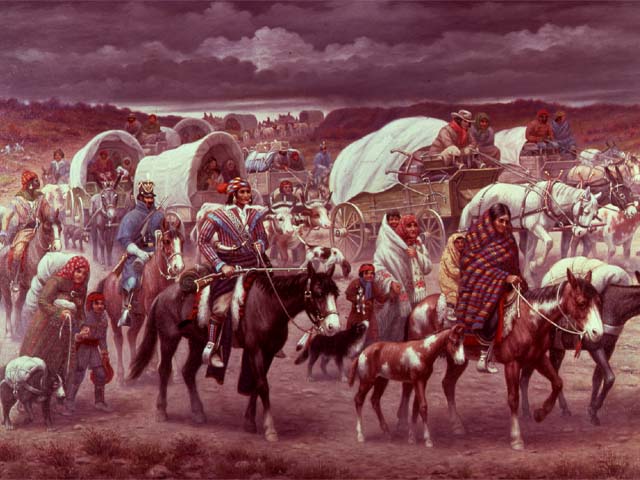 Throughout history the Native Americans were seen as inferior people to the whites. Many tribes and groups were forced to leave their homes due to the expansion of the U.S. According to Chief Joseph the Nez Perces were a group of Native Americans which wanted to live in peace with the white men. Unfortunately the U.S. government ignored this plea to live in peace and continued their expansion. The U.S. was willing to kill the Nez Perces if they wouldn’t leave from the territory that was soon to be acquired. This picture shows a group of Native Americans who are traveling west to find a new home. The picture reflects the second stanza of this song which states that there should be “Nothing to kill or die for”, this is something that the Native Americans believed in. Without something to kill or die for the Native Americans would have kept their homes. The lines “Imagine all the people” “Living life in peace” reflect the attitude of the Native Americans towards the white men. The Native Americans wanted to live in peace so that no blood would be shed. John Lennon conveys the idea that he wants to see the world in peace so incidents like the Native Americans losing their homes and being forced to move wouldn’t happen again.
Sources:
Wednesday, March 26, 2008
Journal Entry- March 26,2008
Aim: Students will better understand the literary term allusion in Joseph's speech. What is rhetoric? Students will read Chief Joseph's Speech "I will fight no more Forever"
Do Now: Read an excerpt from Chief Joseph’s speech.
Interpret the following quotes:
“The Earth is the mother of all people and all people should have equal rights upon it." (Chief Joseph).
Answer on your Blogs:
1.How is the art of rhetoric evident in Chief Joseph’s speech?
The art of rhetoric is the art of persuasive speech. Chief Joseph has the art of rhetoric, which is evident through the way he talks. During the last part of the speech we read it was clear how he was persuading the American government to see the Native Americans as common and not inferior people. If the American People do this, then they would be treated differently and thus benefit the Native Americans.
2.Who is he addressing in this speech?
In this speech Chief Joseph is addressing the American people.
3.Who is he indicting and why?
Joseph is indicting the US of forcing the Native Americans to leave their native land and pushing them to live in reservations. He surely believes that every human should have the right to live like the others, in equality.
4.Identify any heroic characteristics?
A heroic characteristic that I see in Chief Joseph is courage. It takes a lot to go up to the government and Chief Josph had the courage to stand up to someone who holds a higher postition. It was also very heroic of him to stand up for the better of the people. Most importaqntly it was heroic of him to stand up for everyone in the world as he did because he said that it did not matter from where you were from, what religion you practiced because we are all from 'Mother Earth' wanting to have the same equall rights.
5.Why is this speech Protest Literature?
This is a form of Protest Literature because Chief Joseph is protesting for equal rights for the Native Americans among the Americans. He said that he wants equality for him and his people. Protest Literature protest something and that was evident with the speech we read because he wants a fair treatment.
Do Now: Read an excerpt from Chief Joseph’s speech.
Interpret the following quotes:
“The Earth is the mother of all people and all people should have equal rights upon it." (Chief Joseph).
Answer on your Blogs:
1.How is the art of rhetoric evident in Chief Joseph’s speech?
The art of rhetoric is the art of persuasive speech. Chief Joseph has the art of rhetoric, which is evident through the way he talks. During the last part of the speech we read it was clear how he was persuading the American government to see the Native Americans as common and not inferior people. If the American People do this, then they would be treated differently and thus benefit the Native Americans.
2.Who is he addressing in this speech?
In this speech Chief Joseph is addressing the American people.
3.Who is he indicting and why?
Joseph is indicting the US of forcing the Native Americans to leave their native land and pushing them to live in reservations. He surely believes that every human should have the right to live like the others, in equality.
4.Identify any heroic characteristics?
A heroic characteristic that I see in Chief Joseph is courage. It takes a lot to go up to the government and Chief Josph had the courage to stand up to someone who holds a higher postition. It was also very heroic of him to stand up for the better of the people. Most importaqntly it was heroic of him to stand up for everyone in the world as he did because he said that it did not matter from where you were from, what religion you practiced because we are all from 'Mother Earth' wanting to have the same equall rights.
5.Why is this speech Protest Literature?
This is a form of Protest Literature because Chief Joseph is protesting for equal rights for the Native Americans among the Americans. He said that he wants equality for him and his people. Protest Literature protest something and that was evident with the speech we read because he wants a fair treatment.
Journal Entry-March 24-25, 2008
Aim: Ms. Hyde will be out today, but left instructions as follows:
Students will complete watching the Television series Part I of Into The West
Do Now: Compare and contrast what we’ve learned about Native Americans to the movie.
Response: During the last few days we have been watching the television series Into the West, and we have found it it very similar to Cheyenne's Revenge. In Cheyenne's Revenge, the Native Americans were good people who always wanted to maintain peace with there neighbors. In temrs of sharing the land, they were always willing to do so, even with the white men. The Natives would also, usually, trade with the white men the furs they had for any weapons they had. In the movie Into the West, there was a similar situation where you could see how the Native Americans were friendly people, always willing to share the land they possessed. In other occasions, the Native Americans would trade with the white men. Sadly, this did not remain like this because what was once a peaceful, would turn into a horrible disaster for both the Native Americans and the white men. A genocide took place where there was really almost no survivor. Mythological creatures were in both the television series and in the account. Loved by the Buffalo and Lone Wolf, possessed a mythological power of being able foreshadow the tragedy that would soon avenge them. The tragic outcome of these would soon show the people the unfair treatment of the Native Americans. Even though they took place at different time periods and at different places, they both conveyed the same message to the people.
Students will complete watching the Television series Part I of Into The West
Do Now: Compare and contrast what we’ve learned about Native Americans to the movie.
Response: During the last few days we have been watching the television series Into the West, and we have found it it very similar to Cheyenne's Revenge. In Cheyenne's Revenge, the Native Americans were good people who always wanted to maintain peace with there neighbors. In temrs of sharing the land, they were always willing to do so, even with the white men. The Natives would also, usually, trade with the white men the furs they had for any weapons they had. In the movie Into the West, there was a similar situation where you could see how the Native Americans were friendly people, always willing to share the land they possessed. In other occasions, the Native Americans would trade with the white men. Sadly, this did not remain like this because what was once a peaceful, would turn into a horrible disaster for both the Native Americans and the white men. A genocide took place where there was really almost no survivor. Mythological creatures were in both the television series and in the account. Loved by the Buffalo and Lone Wolf, possessed a mythological power of being able foreshadow the tragedy that would soon avenge them. The tragic outcome of these would soon show the people the unfair treatment of the Native Americans. Even though they took place at different time periods and at different places, they both conveyed the same message to the people.
Saturday, March 15, 2008
Vocabulary Words for test on Monday
Vocabulary Words For Quiz on Monday:
1. Symbolism- something that represents something/idea larger than itself.
2. Imagery- the use of vivid or figurative language to represent objects, actions, or ideas.
3. Plot- sequence of events.
4. Characters- a person portrayed in an artistic piece, such as a drama or novel.
5. Setting- time and place.
6. Conflicts- A psychic/mental struggle, often unconscious, resulting from the opposition or simultaneous functioning of mutually exclusive impulses, desires, or tendencies.
7. Point of View- the position of the narrator in relation to the story, as indicated by the narrator's outlook from which the events are depicted and by the attitude toward the characters.
8. Genre- of or pertaining to a distinctive literary type.
9. pestilential- morally harmfull; Deadly.
10. avarice- excessive desire for wealth or gain; greed for riches
11. inhabitants- one that occupies a partitcular place regularly, routinely, or for a period of time.
12. apprehension- the act or power of perceiving or comprehending.
13. clamour- a loud uproar, as from a crowd of people.
14. Dense- thick
15. Fatigue-tiredness; weariness from bodily or mental exertion; a cause of weariness; slow ordeal; exertion: the fatigue of driving for many hours
16. Ardent- fiery; zealous
17. Peril- danger
18. Morality- agreement of rules of right conduct
19. Loathsome- arousing intense dislike and disgust
20. Copious- plentiful; abundant
21. Improvident- shortsighted; failing to provide for the future
22. Apprehensions- feeling of anxiety or fear that something bad or unpleasant will happen; ; taking of a criminal into custody, the power or ability to grasp the importance, significance or meaning of something
23. procured- to obtain something, especially by effort, to provide somebody for prostitution
24. dejected- feeling or showing sadness and lack of hope, especially because of disappointment
25. accursed- enduring the effects of a curse; horrible or hateful
26. quadrant- a 90 degree arc representing one fourth of the circumference of a circle. The area bounded by a quadrant and the two perpendicular lines that connect it to the center of the circle.
27. Kindred- close to somebody or something else because of similar qualities or interests. Related to somebody by blood. (n) closeness to somebody not related to you by blood based, e.g. on similarity of character or interest. Relationship by blood, or less strictly by marriage
28. Trudge- to walk, esp. laboriously or wearily: to trudge up a long flight of steps.
29. Floundering- To make clumsy attempts to move or regain one's balance
30. Ecstasy- an overpowering emotion or exaltation; a state of sudden, intense feeling
31. Writhing- to twist the body about, or squirm, as in pain, violent effort, etc.
32. Cud- the portion of food that a ruminant returns from the first stomach to the mouth to chew a second time
33. Vile- repulsive or disgusting, as to the senses or feelings: a vile odor
34. Zest- hearty enjoyment
35. Ardent- having, expressive of, or characterized by intense feeling; passionate; fervent: an ardent vow; ardent love. Intense devotion.
36. Peril- exposure to the risk of being injured, destroyed, or lost
37. Gape- to stare with open mouth, as in wonder
38. Ammunition- the material fired, scattered, dropped, or detonated from any weapon, as bombs or rockets, and esp. shot, shrapnel, bullets, or shells fired by guns
39. Repellent- something that repels, as a substance that keeps away insects
40. Platoon- a military unit consisting of two or more squads or sections and a headquarters
41. My Khe- place in Vietnam
42. Rhetoric- The art or study of using language effectively and persuasively.
43. Chicano- a Mexican-American.
44. Aztlan- The American Southwest, specifically the territory of northern Mexico ceded to the United States by the Treaty of Guadalupe Hidalgo in 1848. The term is used especially by Chicano-rights activists.
45. Metiza [Spanish]- a woman of mixed racial ancestry, especially one of mixed European and Native American ancestry.
46. Diaspora- a migration or scattering of a group of people
47. Jibara [Spanish]- a girl or woman of rural Puerto Rico, female peasant
48. Shtetl- one of the small Jewish communities formerly found in Eastern Europe.
49. Forbears- ancestors (a variant spelling of forebears).
50. Mija, negra, ne [Spanish]- affectionate terms for girls or women.
51. Caribena [Spanish]- a girl or woman of the Caribbean islands.
52. Boricua [Spanish]- Puerto Rican
53. Taino- A member of an Arawak people of the Greater Antilles and the Bahamas who became extinct under Spanish colonization during the 16th century.
54. Bi-Lingual- using or able to use two languages especially with equal fluency
55. Bi-cultural- of, relating to, or including two distinct cultures
56. Exotic- strikingly, excitingly, or mysteriously different or unusual. introduced from another country : not native to the place where found
57. Inferior- of low or lower degree or rank
58. Alien- belonging or relating to another person, place, or thing : strange b: relating, belonging, or owing allegiance to another country or government : foreign c: exotic 12: differing in nature or character typically to the point of incompatibility
59. Token- an outward sign or expression
60. Bi-lateral- having two sides. affecting reciprocally two nations or parties
61. Gringo- a foreigner in Spain or Latin America especially when of English or American origin; broadly : a non-Hispanic person
62. Paradox- a statement that is seemingly contradictory or opposed to common sense and yet is perhaps true
63. Neurosis- a mental and emotional disorder that affects only part of the personality, is accompanied by a less distorted perception of reality than in a psychosis, does not result in disturbance of the use of language, and is accompanied by various physical, physiological, and mental disturbances (as visceral symptoms, anxieties, or phobias)
64. Sterilization- to make sterile: as a: to cause (land) to become unfruitful b (1): to deprive of the power of reproducing (2): to make incapable of germination c: to make powerless or useless usually by restraining from a normal function, relation, or participation
65. Vanquished- to gain mastery over (an emotion, passion, or temptation) to overcome in battle : subdue completely 2 : to defeat in a conflict or contest
66. Moors-followers of the religion of Islam who conquered Spain during the 700s and who lost most of their territory by the late 1200s
67. Barrios- a Spanish-speaking quarter or neighborhood in a city or town in the United States especially in the Southwest
68. Bigotry- a person obstinately or intolerantly devoted to his or her own opinions and prejudices; especially, one who regards or treats the members of a group (as a racial or ethnic group) with hatred and intolerance
69. Dejection- lowness of spirits
70. Exploitation- to make use of meanly or unfairly for one's own advantage ;exploiting migrant farm workers
71. Fierce- violently hostile or aggressive in temperament b: given to fighting or killing marked by unrestrained zeal or vehemence
72. Mariachi- a Mexican street band; also, a musician belonging to such a band
73. Barren- not reproducing: as a: incapable of producing offspring —used especially of females or matings b: not yet or not recently pregnant c: habitually failing to fruit 2: not productive: as a: producing little or no vegetation
1. Symbolism- something that represents something/idea larger than itself.
2. Imagery- the use of vivid or figurative language to represent objects, actions, or ideas.
3. Plot- sequence of events.
4. Characters- a person portrayed in an artistic piece, such as a drama or novel.
5. Setting- time and place.
6. Conflicts- A psychic/mental struggle, often unconscious, resulting from the opposition or simultaneous functioning of mutually exclusive impulses, desires, or tendencies.
7. Point of View- the position of the narrator in relation to the story, as indicated by the narrator's outlook from which the events are depicted and by the attitude toward the characters.
8. Genre- of or pertaining to a distinctive literary type.
9. pestilential- morally harmfull; Deadly.
10. avarice- excessive desire for wealth or gain; greed for riches
11. inhabitants- one that occupies a partitcular place regularly, routinely, or for a period of time.
12. apprehension- the act or power of perceiving or comprehending.
13. clamour- a loud uproar, as from a crowd of people.
14. Dense- thick
15. Fatigue-tiredness; weariness from bodily or mental exertion; a cause of weariness; slow ordeal; exertion: the fatigue of driving for many hours
16. Ardent- fiery; zealous
17. Peril- danger
18. Morality- agreement of rules of right conduct
19. Loathsome- arousing intense dislike and disgust
20. Copious- plentiful; abundant
21. Improvident- shortsighted; failing to provide for the future
22. Apprehensions- feeling of anxiety or fear that something bad or unpleasant will happen; ; taking of a criminal into custody, the power or ability to grasp the importance, significance or meaning of something
23. procured- to obtain something, especially by effort, to provide somebody for prostitution
24. dejected- feeling or showing sadness and lack of hope, especially because of disappointment
25. accursed- enduring the effects of a curse; horrible or hateful
26. quadrant- a 90 degree arc representing one fourth of the circumference of a circle. The area bounded by a quadrant and the two perpendicular lines that connect it to the center of the circle.
27. Kindred- close to somebody or something else because of similar qualities or interests. Related to somebody by blood. (n) closeness to somebody not related to you by blood based, e.g. on similarity of character or interest. Relationship by blood, or less strictly by marriage
28. Trudge- to walk, esp. laboriously or wearily: to trudge up a long flight of steps.
29. Floundering- To make clumsy attempts to move or regain one's balance
30. Ecstasy- an overpowering emotion or exaltation; a state of sudden, intense feeling
31. Writhing- to twist the body about, or squirm, as in pain, violent effort, etc.
32. Cud- the portion of food that a ruminant returns from the first stomach to the mouth to chew a second time
33. Vile- repulsive or disgusting, as to the senses or feelings: a vile odor
34. Zest- hearty enjoyment
35. Ardent- having, expressive of, or characterized by intense feeling; passionate; fervent: an ardent vow; ardent love. Intense devotion.
36. Peril- exposure to the risk of being injured, destroyed, or lost
37. Gape- to stare with open mouth, as in wonder
38. Ammunition- the material fired, scattered, dropped, or detonated from any weapon, as bombs or rockets, and esp. shot, shrapnel, bullets, or shells fired by guns
39. Repellent- something that repels, as a substance that keeps away insects
40. Platoon- a military unit consisting of two or more squads or sections and a headquarters
41. My Khe- place in Vietnam
42. Rhetoric- The art or study of using language effectively and persuasively.
43. Chicano- a Mexican-American.
44. Aztlan- The American Southwest, specifically the territory of northern Mexico ceded to the United States by the Treaty of Guadalupe Hidalgo in 1848. The term is used especially by Chicano-rights activists.
45. Metiza [Spanish]- a woman of mixed racial ancestry, especially one of mixed European and Native American ancestry.
46. Diaspora- a migration or scattering of a group of people
47. Jibara [Spanish]- a girl or woman of rural Puerto Rico, female peasant
48. Shtetl- one of the small Jewish communities formerly found in Eastern Europe.
49. Forbears- ancestors (a variant spelling of forebears).
50. Mija, negra, ne [Spanish]- affectionate terms for girls or women.
51. Caribena [Spanish]- a girl or woman of the Caribbean islands.
52. Boricua [Spanish]- Puerto Rican
53. Taino- A member of an Arawak people of the Greater Antilles and the Bahamas who became extinct under Spanish colonization during the 16th century.
54. Bi-Lingual- using or able to use two languages especially with equal fluency
55. Bi-cultural- of, relating to, or including two distinct cultures
56. Exotic- strikingly, excitingly, or mysteriously different or unusual. introduced from another country : not native to the place where found
57. Inferior- of low or lower degree or rank
58. Alien- belonging or relating to another person, place, or thing : strange b: relating, belonging, or owing allegiance to another country or government : foreign c: exotic 12: differing in nature or character typically to the point of incompatibility
59. Token- an outward sign or expression
60. Bi-lateral- having two sides. affecting reciprocally two nations or parties
61. Gringo- a foreigner in Spain or Latin America especially when of English or American origin; broadly : a non-Hispanic person
62. Paradox- a statement that is seemingly contradictory or opposed to common sense and yet is perhaps true
63. Neurosis- a mental and emotional disorder that affects only part of the personality, is accompanied by a less distorted perception of reality than in a psychosis, does not result in disturbance of the use of language, and is accompanied by various physical, physiological, and mental disturbances (as visceral symptoms, anxieties, or phobias)
64. Sterilization- to make sterile: as a: to cause (land) to become unfruitful b (1): to deprive of the power of reproducing
65. Vanquished- to gain mastery over (an emotion, passion, or temptation)
66. Moors-followers of the religion of Islam who conquered Spain during the 700s and who lost most of their territory by the late 1200s
67. Barrios- a Spanish-speaking quarter or neighborhood in a city or town in the United States especially in the Southwest
68. Bigotry- a person obstinately or intolerantly devoted to his or her own opinions and prejudices; especially, one who regards or treats the members of a group (as a racial or ethnic group) with hatred and intolerance
69. Dejection- lowness of spirits
70. Exploitation- to make use of meanly or unfairly for one's own advantage ;exploiting migrant farm workers
71. Fierce- violently hostile or aggressive in temperament b: given to fighting or killing marked by unrestrained zeal or vehemence
72. Mariachi- a Mexican street band; also, a musician belonging to such a band
73. Barren- not reproducing: as a: incapable of producing offspring —used especially of females or matings b: not yet or not recently pregnant c: habitually failing to fruit 2: not productive: as a: producing little or no vegetation
Journal Entry-March 14, 2008
Aim: How Manifest Destiny, Cultural Imperialism, and Genocide destroyed Native American cultures and heritage.Examining Native American history and experience through literary genres.
Do Now: click on the following links to learn about the meaning of the terms:
Manifest Destiny, Cultural Imperialism, and Genocide
Comprehension check questions: Trafzar’s “Cheyenne’s Revenge”
· Can we foreshadow what will happen from the title of this excerpt?
We can defintely know that there will be revenge because the title of the excerpt is "Cheyenne Revenge".
· Who are the protagonists?
The protagonist are Lone Wolf and Tall Bear.
· Who are the antagonist?
The antagonist are the Bluecoats.
· What is the setting [time and place]?
The setting is Sand Creek, Colorado 1864.
· What is the central conflict?
The central conflict is the belief the Bluecoats of thinking that the Indians are inferior to them.
· Select One character and characterize.
Lone Wolf is heroic becuse he wanted to get revenge for what had happened to his people. Lone Wolf was also very courages to take a step up to do what he had to do. Lone Wolf was also very determined to keep on going to fight the Bluecoats, even if he didn't have the best armor
· What is the point of view?
The point of view is 3rd.
· Any symbolism?
I believe that the Lance symbolizes the defense the Natives had to continue on in the battle to seek revenge.
Critical thinking Questions:
1. How are Manifest Destiny, Cultural Imperialism, and Genocide evident in this excerpt?
The Americans thought that they had the divne right to expand to the west. By expanding to the west, they also expresses cultural imperialism because they wanted the Indians to accustom to their new religious ideas. But at the same time it was a genocide because the Native Americans were killed without compassion.
2. How does the defeat of Lone Wolf and Tall Bear accurately characterize the Native American condition?
Their deaft showed their lack of equipment to deaft the Bluecoats. This shows how they had no power or say in almost anything.
3. What does Tall Bear’s vision quest reveal about the spiritual and natural beliefs of Native Americans as illustrated the folktales you’ve read?
This reveals that the Natives believe in any vision that they have as long as a mythological creatures are involved.
4. What does Silas Soule represent? Is his characterization real or embellished? Author’s responsibility.
Silas Solue represents and act of hope for the Native Americans, especially for Lone Wolf. This character is characterized as a dynamic character.
5. How can this story be an example as both an allusion and historical analogy? Think about the documentary that we saw. Trail of Tears, Wounded Knee etc…
This story tell about how the Native Americans came to be about after a course of time. This explains what small tribes like these Native Americans, came to be about. It also shows how badly the Natives were treated, but yet still there were some good people who were willning to help them at all cost.
Do Now: click on the following links to learn about the meaning of the terms:
Manifest Destiny, Cultural Imperialism, and Genocide
Comprehension check questions: Trafzar’s “Cheyenne’s Revenge”
· Can we foreshadow what will happen from the title of this excerpt?
We can defintely know that there will be revenge because the title of the excerpt is "Cheyenne Revenge".
· Who are the protagonists?
The protagonist are Lone Wolf and Tall Bear.
· Who are the antagonist?
The antagonist are the Bluecoats.
· What is the setting [time and place]?
The setting is Sand Creek, Colorado 1864.
· What is the central conflict?
The central conflict is the belief the Bluecoats of thinking that the Indians are inferior to them.
· Select One character and characterize.
Lone Wolf is heroic becuse he wanted to get revenge for what had happened to his people. Lone Wolf was also very courages to take a step up to do what he had to do. Lone Wolf was also very determined to keep on going to fight the Bluecoats, even if he didn't have the best armor
· What is the point of view?
The point of view is 3rd.
· Any symbolism?
I believe that the Lance symbolizes the defense the Natives had to continue on in the battle to seek revenge.
Critical thinking Questions:
1. How are Manifest Destiny, Cultural Imperialism, and Genocide evident in this excerpt?
The Americans thought that they had the divne right to expand to the west. By expanding to the west, they also expresses cultural imperialism because they wanted the Indians to accustom to their new religious ideas. But at the same time it was a genocide because the Native Americans were killed without compassion.
2. How does the defeat of Lone Wolf and Tall Bear accurately characterize the Native American condition?
Their deaft showed their lack of equipment to deaft the Bluecoats. This shows how they had no power or say in almost anything.
3. What does Tall Bear’s vision quest reveal about the spiritual and natural beliefs of Native Americans as illustrated the folktales you’ve read?
This reveals that the Natives believe in any vision that they have as long as a mythological creatures are involved.
4. What does Silas Soule represent? Is his characterization real or embellished? Author’s responsibility.
Silas Solue represents and act of hope for the Native Americans, especially for Lone Wolf. This character is characterized as a dynamic character.
5. How can this story be an example as both an allusion and historical analogy? Think about the documentary that we saw. Trail of Tears, Wounded Knee etc…
This story tell about how the Native Americans came to be about after a course of time. This explains what small tribes like these Native Americans, came to be about. It also shows how badly the Natives were treated, but yet still there were some good people who were willning to help them at all cost.
Journal Entry-March12-13, 2008
Aim: Students will use prior knowledge to understand Native American culture
Do Now: How can you connect man and nature from your researched folklores?
Share with class.
From the White Buffalo Woman, I was able to percieve that a nature is very important to Native Americans because they use nature as their source of explaination to why they are here and many other questions on life. Nature is also very imporatnt to them because they depend on it, it could be considered as their source of food. Nature itself is very important to them because it is holy because it plays an important role inreligious ceremonys. Such as when the Lakota and Sioux recieved their pipe.
Recall: from your Global studies class what is imperialism. Now recall the documentary we viewed last week together with your notes and identify any system of imperialism as it pertains to Native Americans.
Imperialism was a time in late 1800s early 1900s, when powerful nations like Great Britain annexed territories around the world for the benefit of their industrialization. When we previously watched the documentary last week, the English were practicing Imperialism because Custer played a part in pushing Native Americans to the west of the US. It was almost like a genocide to the Native Americans.
Do Now: How can you connect man and nature from your researched folklores?
Share with class.
From the White Buffalo Woman, I was able to percieve that a nature is very important to Native Americans because they use nature as their source of explaination to why they are here and many other questions on life. Nature is also very imporatnt to them because they depend on it, it could be considered as their source of food. Nature itself is very important to them because it is holy because it plays an important role inreligious ceremonys. Such as when the Lakota and Sioux recieved their pipe.
Recall: from your Global studies class what is imperialism. Now recall the documentary we viewed last week together with your notes and identify any system of imperialism as it pertains to Native Americans.
Imperialism was a time in late 1800s early 1900s, when powerful nations like Great Britain annexed territories around the world for the benefit of their industrialization. When we previously watched the documentary last week, the English were practicing Imperialism because Custer played a part in pushing Native Americans to the west of the US. It was almost like a genocide to the Native Americans.
Journal Entry-March10-11, 2008
Aim: Students will transfer their understanding of the Oral Tradition to explain their Native American Folktale.
Students will identify parallels between their folktales.Students will annotate and analyze their folktales for any literary terms.
Do Now: compare your folktale to the documentary we saw last week on Native Americans:
1. How is your folktale representative of Native Americans?
The folktale is about the Plain Tribes; Lakota and Sioux that tells about how they sacred pipie and how they are to use it in a cermonyThis is very important to the Lakota or Sioux because it is sacered to them in their ceremony.
2. Does it represent a specific Native American tribe?
This folktale represents the Lakota and Sioux, which are the Native American tribes in the Plains.
3. What is mythological about your folktale?
Something mythological about this is the White Buffalo Woman. She was 1/2 woman and 1/2 buffalo.
4. What literary terms did you identify in your folktale?
characterization-imagery on the white buffalo woman
setting-important setting, Colorado...Sand Creek.
Students will identify parallels between their folktales.Students will annotate and analyze their folktales for any literary terms.
Do Now: compare your folktale to the documentary we saw last week on Native Americans:
1. How is your folktale representative of Native Americans?
The folktale is about the Plain Tribes; Lakota and Sioux that tells about how they sacred pipie and how they are to use it in a cermonyThis is very important to the Lakota or Sioux because it is sacered to them in their ceremony.
2. Does it represent a specific Native American tribe?
This folktale represents the Lakota and Sioux, which are the Native American tribes in the Plains.
3. What is mythological about your folktale?
Something mythological about this is the White Buffalo Woman. She was 1/2 woman and 1/2 buffalo.
4. What literary terms did you identify in your folktale?
characterization-imagery on the white buffalo woman
setting-important setting, Colorado...Sand Creek.
Journal Entry-March 7, 2008
Aim: Students will transfer their understanding of Oral Tradition and Creation mythology to a Native American short story: Iroquois: “The World on the Turtle’s Back.”
Students will analyze the story for comprehension and critical thinking.Students will identify literary elements.
Do Now:
1. What is a myth? Do you know of any?
A myth is a sacred story concerning the origins of the world or how the world and the creations in it came to be in their present form. I don't really recall a myth at this time.
2. What is a Folklore? Can you recall a Folklore?
A folklore is a tradition, custom or belief of people. A tradition people have is to celebrate holidays.
3. What do you think is creation mythology?
A creation myth is a myth that probably tells about the creation of life, tribes, or animals.
Key Questions and Analysis:
How does the folklore attempt to explain Creation? Why?
It attempts to tell the story about how things started or came about.
How does it parallel to Christian-Biblical Creation? Explain similarities and differences using a Venn Diagram.
Students will analyze the story for comprehension and critical thinking.Students will identify literary elements.
Do Now:
1. What is a myth? Do you know of any?
A myth is a sacred story concerning the origins of the world or how the world and the creations in it came to be in their present form. I don't really recall a myth at this time.
2. What is a Folklore? Can you recall a Folklore?
A folklore is a tradition, custom or belief of people. A tradition people have is to celebrate holidays.
3. What do you think is creation mythology?
A creation myth is a myth that probably tells about the creation of life, tribes, or animals.
Key Questions and Analysis:
How does the folklore attempt to explain Creation? Why?
It attempts to tell the story about how things started or came about.
How does it parallel to Christian-Biblical Creation? Explain similarities and differences using a Venn Diagram.
Journal Entry-March6,2008
Aim: Introduction to “Oral Tradition” of Native American culture and imperialism and forced genocide.
Review of “spoken word” and speech in culture: importance of the oral word, purpose of the spoken word, and effects of the oral tradition.
Students will make connection to the oral tradition within their own cultures.
Students will identify superstition and Folklore in Creationism as themes:
Purpose of Creation mythology
Universality of Creation MythSimilarities of Creation Myth
Do Now: Watch a 22mins film on the history of Native Americans.
Students will take notes while watching the documentary on Native Americans.
What is an oral tradition in your family or amongst your friends?
Response: In my family, our oral traditions involve my parents telling me and my older brother stories of when they were younger. They tell us stories based on their lives as kids, the problems they faced and what they had to go through when they got married. My dad likes to tell us about his life when he was living with his grandmother.
Review of “spoken word” and speech in culture: importance of the oral word, purpose of the spoken word, and effects of the oral tradition.
Students will make connection to the oral tradition within their own cultures.
Students will identify superstition and Folklore in Creationism as themes:
Purpose of Creation mythology
Universality of Creation MythSimilarities of Creation Myth
Do Now: Watch a 22mins film on the history of Native Americans.
Students will take notes while watching the documentary on Native Americans.
What is an oral tradition in your family or amongst your friends?
Response: In my family, our oral traditions involve my parents telling me and my older brother stories of when they were younger. They tell us stories based on their lives as kids, the problems they faced and what they had to go through when they got married. My dad likes to tell us about his life when he was living with his grandmother.
Journal Entry-March3-5, 2008
Aim: Students will understand the term epic poem.
Students will engage in active reading by identifying the poem’s epic characteristics
Students will make connections
Students will enhance their vocabulary
Do Now: What kind of revolution would you like to fight for and why? Explain in your journals.
Response: I don't know for what revolution I would fight for, but what I do know is that many people would or do fight for early child marriges. Others fight for civil rights and woman rights too. In Israel, for example, woman are not allowed to drive.
Classwork:
1.Read an excerpt from:
“I am Joaquin/Yo Soy Joaquin” by Rodolfo “Corky” Gonzales
2.Comprehension check:
a. According to the speaker, what struggle have his fathers won and what struggle have they lost?
According to the speaker, his father had won the economic struggle and have lost the cultural struugle. The immagrants have to work hard and only earn minimum wage.
b. What does the speaker wish for his children?
The speaker wishes his children to know who he is. he wants to leave something behind for future generations.
3.Think critically:
a.What kind of revolution do you think the speaker is calling for? Explain.
I think that the speaker ios calling for a Mexican-American civil Right Movement. He also wants others to join him in the fight towards the social an economic struggle.
b. Analyze the poem as an effort to persuade. Who do you believe is the intended audience, and what do you think the poet wants the audience to do, think, and feel?
I belive that the intended audience was the Latin American people who lived in the US during that time of the 1960's. He wants them to join him in the importance of continuing to battle for their social revolution. To recognize his culture, he must fight the social economic battle.
Teacher’s Model:
Epic Characteristics
Evidence from Poem
Hero with high ideals
Courageous deeds
Large-scale setting
Universal ideas
Share out.
Students will engage in active reading by identifying the poem’s epic characteristics
Students will make connections
Students will enhance their vocabulary
Do Now: What kind of revolution would you like to fight for and why? Explain in your journals.
Response: I don't know for what revolution I would fight for, but what I do know is that many people would or do fight for early child marriges. Others fight for civil rights and woman rights too. In Israel, for example, woman are not allowed to drive.
Classwork:
1.Read an excerpt from:
“I am Joaquin/Yo Soy Joaquin” by Rodolfo “Corky” Gonzales
2.Comprehension check:
a. According to the speaker, what struggle have his fathers won and what struggle have they lost?
According to the speaker, his father had won the economic struggle and have lost the cultural struugle. The immagrants have to work hard and only earn minimum wage.
b. What does the speaker wish for his children?
The speaker wishes his children to know who he is. he wants to leave something behind for future generations.
3.Think critically:
a.What kind of revolution do you think the speaker is calling for? Explain.
I think that the speaker ios calling for a Mexican-American civil Right Movement. He also wants others to join him in the fight towards the social an economic struggle.
b. Analyze the poem as an effort to persuade. Who do you believe is the intended audience, and what do you think the poet wants the audience to do, think, and feel?
I belive that the intended audience was the Latin American people who lived in the US during that time of the 1960's. He wants them to join him in the importance of continuing to battle for their social revolution. To recognize his culture, he must fight the social economic battle.
Teacher’s Model:
Epic Characteristics
Evidence from Poem
Hero with high ideals
Courageous deeds
Large-scale setting
Universal ideas
Share out.
Journal Entry-February 28-29, 2008
Aim: Students will synthesize information used from Morales’ “Ending Poem,” to create their own poem or autobiographical sketch.
Students will identify literary elements in the poem “Ending Poem.”
Students will make connections to the text.
Students will research the term legal alien
Do Now: Can you recall a time when you were prejudged? Give details in your journal.
Response: Yes, I do remember that there was time when I went to Mexico and not all but some people, misjudge me differently only because I was coming from the United States. They said I was American. But, when I return back home, here in the United States, people don't see me as an American but rather a Mexican. How ironic is that??? When people do that, you feel out of place...like an outcast.
Classwork:
1.Finish discuss Ending Poem and literary elements.
2.How are these poems a form of protest poetry? And what are they protesting?
Both of these poems; "Ending Poem" and "Legal Alien" are a form of protest literature to society claiming that they are not what society says that they are, but who they claim to be. They are protesting to the label that society gives them.
On “Legal Aliens”:
Read Aloud: Legal Aliens
Comprehension Check:
1. How does the poet say she is viewed by Anglos, and by Mexicans?
The Anglos don't view her as one of them because she is not 100% American. But she is also not viewed as a Mexican either.
Think Critically:
2. How do you think the poet feels about being bilingual and bicultural?
(Think about: how she is viewed by Anglos and Mexicans. Her description of herself in
lines 16-22.)
I believe that she could feel somewhat proud, but at the same time she feels somewhat dissapointed because some people misjudge her.
3. How do you interpret the title “Legal Alien?”
To me it means: Foreigner that belongs where he or she is. She is an American that is seen as an immigrant. "A foreigner in her own homeland".
4.What purpose does the hyphen serve in this poem?
The hyphen could serve as a separtion or jointment.
Cooperative Learning:...This was done in school and the work is hanging in Rm.236
Research the term “legal alien” as it pertains to immigration.
Which Latin American groups of people have the highest migration rate to the United States?
What are the pros and cons of illegal immigrants in a country? Illustrate this on a T chart.Have someone in the group draw a mask to show Bi-lingual, Bi-cultural, Bi-lateral.
Students will identify literary elements in the poem “Ending Poem.”
Students will make connections to the text.
Students will research the term legal alien
Do Now: Can you recall a time when you were prejudged? Give details in your journal.
Response: Yes, I do remember that there was time when I went to Mexico and not all but some people, misjudge me differently only because I was coming from the United States. They said I was American. But, when I return back home, here in the United States, people don't see me as an American but rather a Mexican. How ironic is that??? When people do that, you feel out of place...like an outcast.
Classwork:
1.Finish discuss Ending Poem and literary elements.
2.How are these poems a form of protest poetry? And what are they protesting?
Both of these poems; "Ending Poem" and "Legal Alien" are a form of protest literature to society claiming that they are not what society says that they are, but who they claim to be. They are protesting to the label that society gives them.
On “Legal Aliens”:
Read Aloud: Legal Aliens
Comprehension Check:
1. How does the poet say she is viewed by Anglos, and by Mexicans?
The Anglos don't view her as one of them because she is not 100% American. But she is also not viewed as a Mexican either.
Think Critically:
2. How do you think the poet feels about being bilingual and bicultural?
(Think about: how she is viewed by Anglos and Mexicans. Her description of herself in
lines 16-22.)
I believe that she could feel somewhat proud, but at the same time she feels somewhat dissapointed because some people misjudge her.
3. How do you interpret the title “Legal Alien?”
To me it means: Foreigner that belongs where he or she is. She is an American that is seen as an immigrant. "A foreigner in her own homeland".
4.What purpose does the hyphen serve in this poem?
The hyphen could serve as a separtion or jointment.
Cooperative Learning:...This was done in school and the work is hanging in Rm.236
Research the term “legal alien” as it pertains to immigration.
Which Latin American groups of people have the highest migration rate to the United States?
What are the pros and cons of illegal immigrants in a country? Illustrate this on a T chart.Have someone in the group draw a mask to show Bi-lingual, Bi-cultural, Bi-lateral.
Journal Entry-February 27, 2008
Aim: Students will analyze and understand the complexity of Puerto Rican identity through protest poetry.
Do Now: Do you consider yourself as having mixture of roots? Why or why not?
Response: I do consider myself as having a mixture of roots because I cannot say that I am from one definte place. For example, my parents from Mexico but I was not born there, I was born in the but neither can I say that I am Mexican.
Classwork:
1. What geographical regions can be identified in this poem?
Puerto Rico, the Caribbean, Afirca, Europe, California New York; Manhattan, Bronx.
2.Describe the message within the following verses:
-“History made me”-This qoute can be interpreted as if the author is trying to tell the reader how her ancestry goes back into history to different nationalities. As time passed by, her family's nationality changes until it reaches her, where she finds herself as a product of history/
-“I was born at the crossroads.”-The speaker said that she was born at the crossroads meaning that she choses what she wants to be.
3.Define Caribeña and Taíno.
Caribena [Spanish]- a girl or woman of the Caribbean islands.
Taino- A member of an Arawak people of the Greater Antilles and the Bahamas who became extinct under Spanish colonization during the 16th century.
4.How would you characterize the speaker’s racial and ethnic background?
Hispanic, Puerto Rican Jew.
“Ending Poem” introduces some of the issues that characterize the Puerto Rican identity such as:
a) Puerto Ricans consider themselves a cultural group
b) They struggle to find a place (in terms of social class) within the dominant culture in the United States.
c) Puerto Rican literature in the U.S. reveals a mixture of North American and Puerto Rican cultures, all of which at times comes to a clash.
d) Some struggle to preserve aspects of the Puerto Rican culture while trying to accept their new roles in the United States at the same time
Do Now: Do you consider yourself as having mixture of roots? Why or why not?
Response: I do consider myself as having a mixture of roots because I cannot say that I am from one definte place. For example, my parents from Mexico but I was not born there, I was born in the but neither can I say that I am Mexican.
Classwork:
1. What geographical regions can be identified in this poem?
Puerto Rico, the Caribbean, Afirca, Europe, California New York; Manhattan, Bronx.
2.Describe the message within the following verses:
-“History made me”-This qoute can be interpreted as if the author is trying to tell the reader how her ancestry goes back into history to different nationalities. As time passed by, her family's nationality changes until it reaches her, where she finds herself as a product of history/
-“I was born at the crossroads.”-The speaker said that she was born at the crossroads meaning that she choses what she wants to be.
3.Define Caribeña and Taíno.
Caribena [Spanish]- a girl or woman of the Caribbean islands.
Taino- A member of an Arawak people of the Greater Antilles and the Bahamas who became extinct under Spanish colonization during the 16th century.
4.How would you characterize the speaker’s racial and ethnic background?
Hispanic, Puerto Rican Jew.
“Ending Poem” introduces some of the issues that characterize the Puerto Rican identity such as:
a) Puerto Ricans consider themselves a cultural group
b) They struggle to find a place (in terms of social class) within the dominant culture in the United States.
c) Puerto Rican literature in the U.S. reveals a mixture of North American and Puerto Rican cultures, all of which at times comes to a clash.
d) Some struggle to preserve aspects of the Puerto Rican culture while trying to accept their new roles in the United States at the same time
Journal Entry-February 26, 2008
Aim: Students will volunteer their research findings on the Mexican American Civil Rights Movement and other historical elements of Hispanics in American during the 1960s.
Do Now: Not Aplicable...Because Students will chart their research on last night’s homework assignment and present their findings.
Share Out
Do Now: Not Aplicable...Because Students will chart their research on last night’s homework assignment and present their findings.
Share Out
Journal Entry-February 25, 2008
Theme “Protest Literature”
Aim: We will investigate and research the Chicano/Hispanic/Latino etc. culture and literature in search of protest and revolution.
Students will do research on the meaning of the words Chicano and Aztlán.
Do Now: What do you know, or have noticed, or heard to be stereotypes of Chicano/Hispanic/Latino culture?
Response: As from what I have noticed, the Chicano/Hispanic/Latino Cultutre like to have a large family. These people are very united and tend to do keep their traditions even in a foreign country. They also are very religious and eat very similar foods, but just in different forms.
Aim: We will investigate and research the Chicano/Hispanic/Latino etc. culture and literature in search of protest and revolution.
Students will do research on the meaning of the words Chicano and Aztlán.
Do Now: What do you know, or have noticed, or heard to be stereotypes of Chicano/Hispanic/Latino culture?
Response: As from what I have noticed, the Chicano/Hispanic/Latino Cultutre like to have a large family. These people are very united and tend to do keep their traditions even in a foreign country. They also are very religious and eat very similar foods, but just in different forms.
Sunday, March 2, 2008
“I Am What I Am”
Information Technology High School
Ms. Hyde
English E6
3/2/08
Lourdes Vicuna
"I Am What I Am"
By: Lourdes Vicuna and someone else
I Am What I Am
I am an immigrant of the Americas.
A child of the Lands
Coming only from one place.
Speaking Two Languages, Dos Culturas.
Living in a new world.
I am what I live
Accommodating to a new life.
With no true defined background,
But I know where my roots start.
I am one whole that is split into two pieces
And I am one of the two pieces.
Confused with life and at times speaking Spanglish
Understanding mi hija and communicating with mi hija in only one language.
At times I feel as an outsider
But there is nothing to be ashamed of.
But I am what I am,
Standing strong no matter what the people think.
Spanish or American…
It doesn’t matter what people think,
But who I really am!
A Latin American child, born into America,
Finding who she really is.
I am what I am and I am proud of it.
I have made what I see.
We are who we are and that is what makes US!
Ms. Hyde
English E6
3/2/08
Lourdes Vicuna
"I Am What I Am"
By: Lourdes Vicuna and someone else
I Am What I Am
I am an immigrant of the Americas.
A child of the Lands
Coming only from one place.
Speaking Two Languages, Dos Culturas.
Living in a new world.
I am what I live
Accommodating to a new life.
With no true defined background,
But I know where my roots start.
I am one whole that is split into two pieces
And I am one of the two pieces.
Confused with life and at times speaking Spanglish
Understanding mi hija and communicating with mi hija in only one language.
At times I feel as an outsider
But there is nothing to be ashamed of.
But I am what I am,
Standing strong no matter what the people think.
Spanish or American…
It doesn’t matter what people think,
But who I really am!
A Latin American child, born into America,
Finding who she really is.
I am what I am and I am proud of it.
I have made what I see.
We are who we are and that is what makes US!
Saturday, February 16, 2008
Journal Entry-Febraury 15, 2008
Aim: What is rhetoric and how important is it to protest?
Do Now: Select one of the literary works discussed and analyzed in class and give reasons why this work can be considered the best work that represents protest literature.
Resoponse: I believe that the best literary work that represents protest literature is "America" by james Monroe Whitfield because the Speaker explains how he was taken form his very own homeland to work as a slave when he said "To teare the black man from his soil and force him here to delve and toil". The speaker also empahsizes in this same line ghow salvery is misery and thus protest in this work of literature to slavery.
Do Now: Select one of the literary works discussed and analyzed in class and give reasons why this work can be considered the best work that represents protest literature.
Resoponse: I believe that the best literary work that represents protest literature is "America" by james Monroe Whitfield because the Speaker explains how he was taken form his very own homeland to work as a slave when he said "To teare the black man from his soil and force him here to delve and toil". The speaker also empahsizes in this same line ghow salvery is misery and thus protest in this work of literature to slavery.
Journal Entry-February 14, 2008
Aim: ...Students will review Proofreaders/Edit Marks
Students will peer edit
Do Now: Please review the handouts before exchanging papers. Proof reading will be done by your peers.
Students will peer edit
Do Now: Please review the handouts before exchanging papers. Proof reading will be done by your peers.
Journal Entry-February 12, 2008
Aim: How can we compare protest literature?
Do Now: Complete the vocabulary handout.
Do Now: Complete the vocabulary handout.
Journal Entry-February 11, 2008
Aim: How can we use a Graphic Organizer to better identify and Compare Equianos similarities and differences to Harper's and Whitfields poems?
Do Now: Compare one of the poems to Equiano's poem
Response: I noticed that in the poem "America" by James Monroe Whitfiel is very similar to Equianso slave narrative because both explain how they were taken form their land and forced to be slaves when in lines 7&8 explain in the poem "America", it says "To tear the black man from his soil and forced him here to delve and toil.
Do Now: Compare one of the poems to Equiano's poem
Response: I noticed that in the poem "America" by James Monroe Whitfiel is very similar to Equianso slave narrative because both explain how they were taken form their land and forced to be slaves when in lines 7&8 explain in the poem "America", it says "To tear the black man from his soil and forced him here to delve and toil.
Journal Entry-February 8, 2008
Aim: ...Students will gain insight into the horrifying conditions facing slaves throughout the ordeal.
Use a variety of reading strategies to comprehend an autobiography
Express and support responses to the text: Critical thinking, Scene sketch
Develop vocabulary and word identification skills.
Analyze literary elements in the work
Draw conclusions by critical viewing.
Do Now: Please complete your KWL chart based on slavery.
----------------------------------------------------------------------------------
Use a variety of reading strategies to comprehend an autobiography
Express and support responses to the text: Critical thinking, Scene sketch
Develop vocabulary and word identification skills.
Analyze literary elements in the work
Draw conclusions by critical viewing.
Do Now: Please complete your KWL chart based on slavery.
----------------------------------------------------------------------------------
Journal Entry-February 7, 2008
Aim: What is a Slave Narrative?
Do Now: Explain in one paragraph what you've been taught about slavery in Social Studies. How can slave narratives be form of protest literature?
Response: In my past history education, I was taught that slavery was a crucial turning point in American History. Many people from the Eastern and Southern part of Africa were captured and derrived from a luxiourious life to work in harsh animal like conditions. Families were divided and some died on there way over to the Americas. Many of them got sick and faced a life full of misery and woe. Slave Narratives are a form of protest literature because this type of writting exposes to people the harsh life that they had because they had no human rights.
Do Now: Explain in one paragraph what you've been taught about slavery in Social Studies. How can slave narratives be form of protest literature?
Response: In my past history education, I was taught that slavery was a crucial turning point in American History. Many people from the Eastern and Southern part of Africa were captured and derrived from a luxiourious life to work in harsh animal like conditions. Families were divided and some died on there way over to the Americas. Many of them got sick and faced a life full of misery and woe. Slave Narratives are a form of protest literature because this type of writting exposes to people the harsh life that they had because they had no human rights.
Journal Entry-February 6, 2008
Aim: Students will link their Blog page to my wikispace. Teacher will check for collegeboard.com registration
Do Now: N/A
Do Now: N/A
Journal Entry-February 5, 2008
Aim: How can we integrate technology in this English Course
Do Now: Write a pargraph on how you think technology should be integrated in a English class. What things would you like to do using technology?
Response: Based on this E6 class I would like for most of our work to be posted on our blogs, except for the graded work because than other people could copy l;ike in the previous semester. I would prefer for my work to be graded first and then posted, that way my teacher would know what kind of work I did. I would also like to see how we can use technology to post our resumes on our blogs. Also for our 'Do Nows' we should be able to use the computer to find our response and maybe even possibly do podcast again.
Do Now: Write a pargraph on how you think technology should be integrated in a English class. What things would you like to do using technology?
Response: Based on this E6 class I would like for most of our work to be posted on our blogs, except for the graded work because than other people could copy l;ike in the previous semester. I would prefer for my work to be graded first and then posted, that way my teacher would know what kind of work I did. I would also like to see how we can use technology to post our resumes on our blogs. Also for our 'Do Nows' we should be able to use the computer to find our response and maybe even possibly do podcast again.
Journal Entry-February 4, 2008
Aim: How prepared are you for college?
Do Now: Please answer the aim.
Response: I am not very prepared for college, but I have been looking at college majors and I know what I will do in general, business possibly. I also know what some of the scholarships are out there but I haven't quiet looked at them to the fullest extent.
Do Now: Please answer the aim.
Response: I am not very prepared for college, but I have been looking at college majors and I know what I will do in general, business possibly. I also know what some of the scholarships are out there but I haven't quiet looked at them to the fullest extent.
Journal Entry-February 1, 2008
Aim: Introduction to Course, Classroom policy, Attendance, Contact/Index Cards (name, address, parent(s)/guardian, phone, email). This will be done electronically.
Do Now: N/A
Do Now: N/A
Tuesday, February 12, 2008
Letter to Author of "Ambush": Tim O'Brien
Lourdes Vicuna
86-32 Dragner St
Apt. 6G
Bayside, NY 17528
February 12, 2008
Dear Speaker :
(indent) Not too long ago, in fact just this week, I was reading “Ambush” from Things they Carried, and I must say that I admire your distinctive form of writing. Not every one can write in a way in which concrete imagery makes their writing so unique.
(indent)You started off by giving the reader a basic exposition of what was happening. You then introduced the reader to where the climax was found at, but slowly brought the reader to a common territory, the conclusion. Anyone can explain what happened, but you used concrete imagery such as in paragraph 3. Two thirds into that paragraph you explained as follows: “He wore black clothing and rubber sandals and a gray ammunition belt. His shoulders were slightly stooped, his head cocked to the side as if listening for something. He seemed at ease. He carried his weapon in one hand, muzzle down moving without any hurry up the center of the trail. There was no sound at all---none that I can remember. In a way, it seemed he was part of the morning fog, or my own imagination but here was also the reality of what was happening in my stomach. I had already pulled the pin on a grenade.”
(indent)With that being said, was it because you sensed peril in the upcoming events that you got ready to pull the grenade? Yes, I know that we all have immediate reactions, but don’t you think that your immediate reaction was a bit too harsh? Were you thinking of how this would affect you later: either by bringing remorse feelings to you or feelings of pride because you would be seen as a hero when you returned home?
(indent)I also remember reading on how you were still affected by what you did. The very last paragraph reads as follows: “In the ordinary hours of life I try not to dwell on it, but now and then, when I’m reading a newspaper or just sitting alone in a room, I’ll look up and see the young man coming out of the morning fog. I’ll watch him walk toward me, his shoulders slightly stopped, his head cocked to the side, and he’ll pass within a few yards of me and suddenly smile at some secret thought and then continue up the trail to where it bends into the fog.” I know that when something is bothering me, the best way to remove that feeling is by talking about it. So have you ever tried talking about it? This may sound dumb, but when you talk about it you feel like a burden has been lifted from your shoulders, open yourself up and see for yourself how great it is. Remember that it is never ok to keep all your feelings to yourself because there is only so much your heart can hold. Also, going back to the last paragraph in “Ambush”, do you think that the fact you visualize the young man passing by you and without doing any harm to you is a sign that you heart is telling you that you have forgiven yourself but it is only your mind that is denying it? Don’t forget that you mind and heart may disagree many times with each other, but in the end you can still make the right decision. Your conscience may bother you every now and then, but don't condemn yourself.
(indent) Maybe if you start to write about other things rather than war, it would get your mind away from it. I hope to hear soon from you with responses to all of my questions.
Sincerely,
Lourdes Vicuna
86-32 Dragner St
Apt. 6G
Bayside, NY 17528
February 12, 2008
Dear Speaker :
(indent) Not too long ago, in fact just this week, I was reading “Ambush” from Things they Carried, and I must say that I admire your distinctive form of writing. Not every one can write in a way in which concrete imagery makes their writing so unique.
(indent)You started off by giving the reader a basic exposition of what was happening. You then introduced the reader to where the climax was found at, but slowly brought the reader to a common territory, the conclusion. Anyone can explain what happened, but you used concrete imagery such as in paragraph 3. Two thirds into that paragraph you explained as follows: “He wore black clothing and rubber sandals and a gray ammunition belt. His shoulders were slightly stooped, his head cocked to the side as if listening for something. He seemed at ease. He carried his weapon in one hand, muzzle down moving without any hurry up the center of the trail. There was no sound at all---none that I can remember. In a way, it seemed he was part of the morning fog, or my own imagination but here was also the reality of what was happening in my stomach. I had already pulled the pin on a grenade.”
(indent)With that being said, was it because you sensed peril in the upcoming events that you got ready to pull the grenade? Yes, I know that we all have immediate reactions, but don’t you think that your immediate reaction was a bit too harsh? Were you thinking of how this would affect you later: either by bringing remorse feelings to you or feelings of pride because you would be seen as a hero when you returned home?
(indent)I also remember reading on how you were still affected by what you did. The very last paragraph reads as follows: “In the ordinary hours of life I try not to dwell on it, but now and then, when I’m reading a newspaper or just sitting alone in a room, I’ll look up and see the young man coming out of the morning fog. I’ll watch him walk toward me, his shoulders slightly stopped, his head cocked to the side, and he’ll pass within a few yards of me and suddenly smile at some secret thought and then continue up the trail to where it bends into the fog.” I know that when something is bothering me, the best way to remove that feeling is by talking about it. So have you ever tried talking about it? This may sound dumb, but when you talk about it you feel like a burden has been lifted from your shoulders, open yourself up and see for yourself how great it is. Remember that it is never ok to keep all your feelings to yourself because there is only so much your heart can hold. Also, going back to the last paragraph in “Ambush”, do you think that the fact you visualize the young man passing by you and without doing any harm to you is a sign that you heart is telling you that you have forgiven yourself but it is only your mind that is denying it? Don’t forget that you mind and heart may disagree many times with each other, but in the end you can still make the right decision. Your conscience may bother you every now and then, but don't condemn yourself.
(indent) Maybe if you start to write about other things rather than war, it would get your mind away from it. I hope to hear soon from you with responses to all of my questions.
Sincerely,
Lourdes Vicuna
Sunday, February 10, 2008
Wik-elements
Note To Reader: Here you will find a list of literary elements with their definitions along with examples from any literary text.
(#1-5 correspond to
1. Genre- of or pertaining to a distinctive literary type.
example:
2. Symbolism- something that represents something/idea larger than itself.
example:
3. Imagery- the use of vivid or figurative language to represent objects, actions, or ideas.
example:
4. Plot- sequence of events.
example:
5. Characters- a person portrayed in an artistic piece, such as a drama or novel.
example:
6. Setting- time and place.
example:
7. Conflicts- A psychic/mental struggle, often unconscious, resulting from the opposition or simultaneous functioning of mutually exclusive impulses, desires, or tendencies.
example:
8. Point of View- the position of the narrator in relation to the story, as indicated by the narrator's outlook from which the events are depicted and by the attitude toward the characters.
example:
...still under construction...
(#1-5 correspond to
1. Genre- of or pertaining to a distinctive literary type.
example:
2. Symbolism- something that represents something/idea larger than itself.
example:
3. Imagery- the use of vivid or figurative language to represent objects, actions, or ideas.
example:
4. Plot- sequence of events.
example:
5. Characters- a person portrayed in an artistic piece, such as a drama or novel.
example:
6. Setting- time and place.
example:
7. Conflicts- A psychic/mental struggle, often unconscious, resulting from the opposition or simultaneous functioning of mutually exclusive impulses, desires, or tendencies.
example:
8. Point of View- the position of the narrator in relation to the story, as indicated by the narrator's outlook from which the events are depicted and by the attitude toward the characters.
example:
...still under construction...
Wiki-cabulary
Note To Reader: Here you will find a list of vocabulary words which will be continously updated throughout this Spring Semester 2008.
1. pestilential- morally harmfull; Deadly.
2. avarice- excessive desire for wealth or gain.
3. inhabitants- one that occupies a partitcular place regularly, routinely, or for a period of time.
4. apprehension- the act or power of perceiving or comprehending.
5. clamour- a loud uproar, as from a crowd of people.
(#'s 1-5 are from Olaudah Equiano's Slave Narrative)
1. pestilential- morally harmfull; Deadly.
2. avarice- excessive desire for wealth or gain.
3. inhabitants- one that occupies a partitcular place regularly, routinely, or for a period of time.
4. apprehension- the act or power of perceiving or comprehending.
5. clamour- a loud uproar, as from a crowd of people.
(#'s 1-5 are from Olaudah Equiano's Slave Narrative)
Thursday, February 7, 2008
Olaudah Equiano
Comprehension Check Questions:
1.For what crimes were slaves punished? And what was the punishment?
One of the crimes that the slaves where punished for was running away as mentioned in the excerpt. When ever the slaves had the chance to run away, the would do so even if it meant throwing themselves in the water. As a result, the slave traders would stop the boat and go after the fugitives. Some would then die from suffocation, hunger and illnesses.
Critical Thinking Questions:
2.Interpret: Why does Equiano blame the illness aboard the ship on the “improvident avarice” of the traders?
Equiano blames the illness aboard the ship on the "improvident avarice" of the traders because if it weren't for the traders ambition to have money than the Slave Trade would have been unnecessary. That is why he says "This produced copious perspirations, so that the air soon became unfit for respiration, from a variety of loathsome smells, and brought on a sickness among the slaves, of which many died, thus falling victims to the improvident avarice, as I may call it, of their purchasers" knowing that it all has to so with money.
Support from the text:
3.How can you tell that Equiano has a great zest for life despite his assertion that he wanted to die?
Despite all the harships that exist in life, you could tell that Equiano has great zest for life when he describe what he saw in Barbadoes whit great excitement such as the horses. His excitement shows the reader how optimistic he is about life.
4.Infer: What does this passage reveal about the author?
This passage could probably refer that the author was a slave who was going through all of this, as he is telling the story. This passage could also refer to the negativity that exists in slavery.
5.Draw conclusion: Explain what a variety of languages indicates about the slave trade.
The fact that there are so many languages spoken in one country or that the community is very diverse in the physical sense, indictaes that the Slave Trade had a great part in this. Because of the Slave Trade, many people from different cultures migrated and thus stayed at this new place. Therefore the diversity we may see in our community is due to the Slave Trade. A great example of this is the Carribean, where ancestry goes as far as Africa.
Thematic Focus:
6.When one culture dominates another, what troubles might society face?
When one culture dominates another it creates tension and cruelty. The dominant country we be overflowed by it's power and will soon become corrupt. This could even lead to rebellion as seen in the past in Haiti, the greatest Slave Rebellion ever.
1.For what crimes were slaves punished? And what was the punishment?
One of the crimes that the slaves where punished for was running away as mentioned in the excerpt. When ever the slaves had the chance to run away, the would do so even if it meant throwing themselves in the water. As a result, the slave traders would stop the boat and go after the fugitives. Some would then die from suffocation, hunger and illnesses.
Critical Thinking Questions:
2.Interpret: Why does Equiano blame the illness aboard the ship on the “improvident avarice” of the traders?
Equiano blames the illness aboard the ship on the "improvident avarice" of the traders because if it weren't for the traders ambition to have money than the Slave Trade would have been unnecessary. That is why he says "This produced copious perspirations, so that the air soon became unfit for respiration, from a variety of loathsome smells, and brought on a sickness among the slaves, of which many died, thus falling victims to the improvident avarice, as I may call it, of their purchasers" knowing that it all has to so with money.
Support from the text:
3.How can you tell that Equiano has a great zest for life despite his assertion that he wanted to die?
Despite all the harships that exist in life, you could tell that Equiano has great zest for life when he describe what he saw in Barbadoes whit great excitement such as the horses. His excitement shows the reader how optimistic he is about life.
4.Infer: What does this passage reveal about the author?
This passage could probably refer that the author was a slave who was going through all of this, as he is telling the story. This passage could also refer to the negativity that exists in slavery.
5.Draw conclusion: Explain what a variety of languages indicates about the slave trade.
The fact that there are so many languages spoken in one country or that the community is very diverse in the physical sense, indictaes that the Slave Trade had a great part in this. Because of the Slave Trade, many people from different cultures migrated and thus stayed at this new place. Therefore the diversity we may see in our community is due to the Slave Trade. A great example of this is the Carribean, where ancestry goes as far as Africa.
Thematic Focus:
6.When one culture dominates another, what troubles might society face?
When one culture dominates another it creates tension and cruelty. The dominant country we be overflowed by it's power and will soon become corrupt. This could even lead to rebellion as seen in the past in Haiti, the greatest Slave Rebellion ever.
Tuesday, February 5, 2008
Literary Response to Quotes by D. H. Lawrence and Emily Dickinson
"I never saw a wild thing feel sorry for itself. A small bird will drop dead from a bough. Without ever feeling sorry for itself."- D. H. Lawrence
This quote by D. H. Lawrence explains the significance of a pity feeling for oneself and it's results. If something is wild, then this being is very open-minded to almost any thing and is a risk taker. By analyzing this quote I understand the importance of not feeling sorry for everything bad that happens iin my life, but rather moving on to succeed in life and make the most out of a situtation. If something so small like a bird did not feel sorry, than why should a humanbeing? We know that not all the time will situations favor us, but we prove to be who we really are when we move on. I was also able to understand that our attitude has a lot to do with how our life turns out to be.
"I am nobody, who are you?"-Emily Dickinson
I am a person who wants a supperior education than the average person. I am someone who wants to succeed in life and feel grateful for what I have done for myself. I am an honor student who wants to feel satisfation looking back at what I have done. I also am someone who wants to have a career that can help others achieve what they want. It will be difficult, but not impossible. I am what I do. I am Lourdes Vicuna and I am somebody, who are you?
This quote by D. H. Lawrence explains the significance of a pity feeling for oneself and it's results. If something is wild, then this being is very open-minded to almost any thing and is a risk taker. By analyzing this quote I understand the importance of not feeling sorry for everything bad that happens iin my life, but rather moving on to succeed in life and make the most out of a situtation. If something so small like a bird did not feel sorry, than why should a humanbeing? We know that not all the time will situations favor us, but we prove to be who we really are when we move on. I was also able to understand that our attitude has a lot to do with how our life turns out to be.
"I am nobody, who are you?"-Emily Dickinson
I am a person who wants a supperior education than the average person. I am someone who wants to succeed in life and feel grateful for what I have done for myself. I am an honor student who wants to feel satisfation looking back at what I have done. I also am someone who wants to have a career that can help others achieve what they want. It will be difficult, but not impossible. I am what I do. I am Lourdes Vicuna and I am somebody, who are you?
Subscribe to:
Posts (Atom)